
Stop pasting replies between your agents.
You run Claude Code, Codex and OpenCode. Each one has its own window, its own memory and its own idea of what you asked. You carry answers from one to the other and re-explain the task every time a context window fills up.
harnsy connects them into one team with roles. You talk to one lead agent; it hands out tasks to the roles it needs, and the team's questions and finished work come back to you.
Your harnesses, settings, skills and subscriptions stay as they are. harnsy runs on your machine.
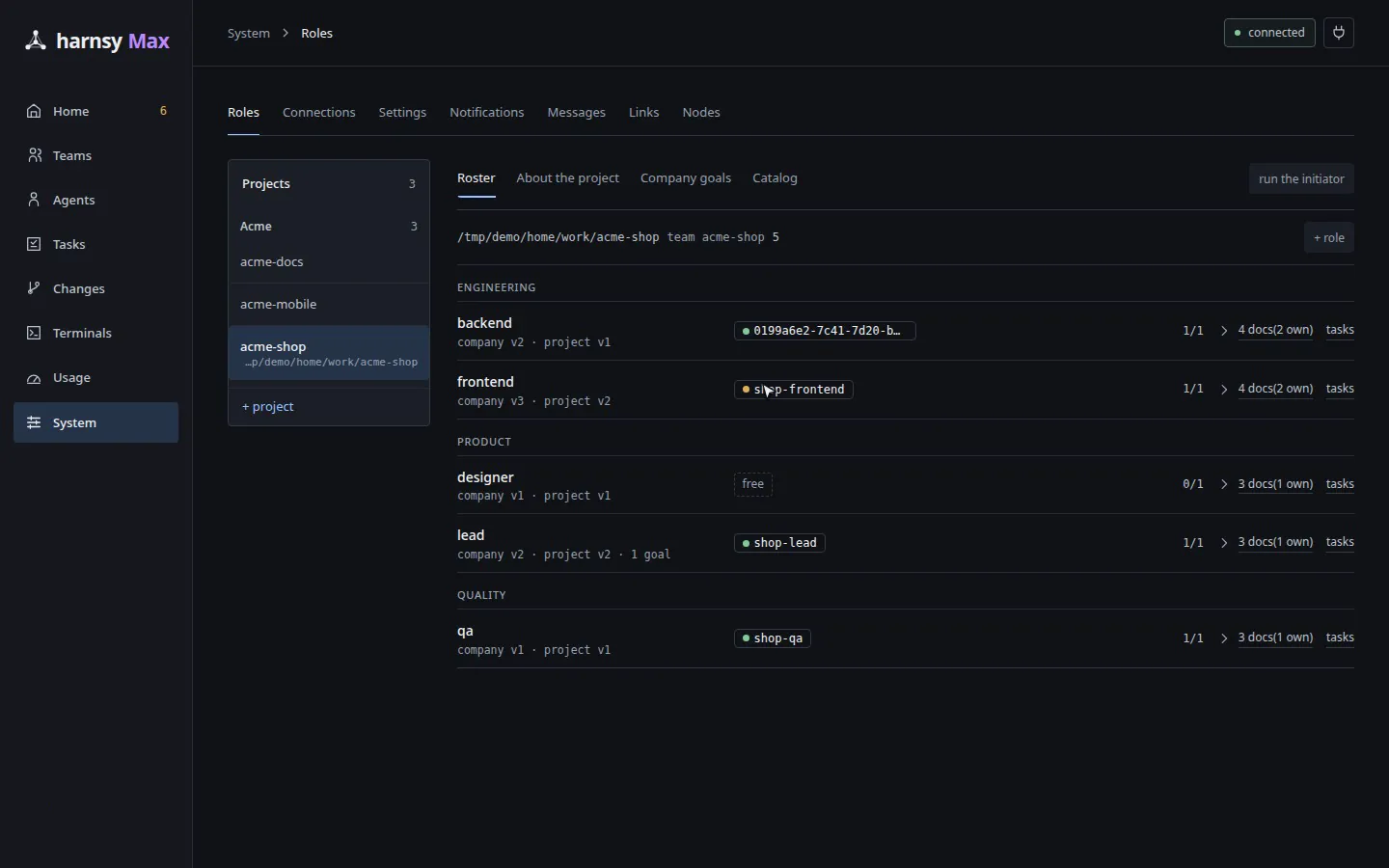
Watch it work · 55 s (sample data)
- Messages land in the running session. Agents in different harnesses write to each other directly, through each harness's own mechanism. No local agent polls an inbox, and you stop copying answers between windows.
- Roles with a written job. Each agent holds one role (lead, analyst, developer, tester…) and reads its versioned role document when it starts.
- Work outlives a context window. When an agent's context fills up, it writes a handover note and a fresh agent takes the same role.
- Tasks on a board. The lead turns your request into tasks for each role, with subtasks, checklists and attached proof. You accept a result or return it.
- Answers from the dashboard. When an agent stops on a question or a permission request, the dashboard shows it with its options, and one click answers it in the agent's session.
- Terminals. Every agent runs in a terminal tab of its own (tmux on Linux and macOS, harnsy's own terminal on Windows); watch and type into any of them from the dashboard, and reopen the team after a reboot.
- Changes. Every git worktree the agents work in, with its branch, task, agent, files and full diff. When two worktrees touch the same file, Home warns you and the leads concerned are told.
- The right model for the job. Let Codex review what Claude wrote. Send mechanical work to a local or cheaper model you have set up in OpenCode.
The dashboard runs at http://127.0.0.1:7788, on your machine only.
Tell your agent:
Install harnsy following https://harnsy.dev/llms.txt
Or run one command yourself.
Linux and macOS:
curl -fsSL https://harnsy.dev/install.sh | shWindows (PowerShell):
irm https://harnsy.dev/install.ps1 | iexThe installer shows every change to your settings files and asks before each one. harnsy uninstall removes what the installer added and keeps your data. To upgrade, run the same command again.
You need at least one harness installed and signed in: Claude Code, Codex or OpenCode. To have harnsy open agents for you, you need tmux on Linux and macOS, or on Windows 10 version 1809 and later harnsy's own terminal host (0.8.0 and later). Without a terminal, messages, teams and the dashboard still work. Details: harnsy.dev/install.
harnsy runs one project with up to 10 agents at once on one machine. A harnsy Max key turns on, in the same build:
- more projects and agents at once, as your key allows;
- other machines joined as one team: a local agent asks an agent on a server for a report. Messages go over harnsy's bus, not over ssh;
- several Claude, Codex and OpenCode subscriptions as connections, with each agent started on the one you pick;
- Usage: the limits of each subscription and your spend by project, team, role or agent.
Feature by feature: harnsy.dev/features.
- Not a new harness or agent runtime. It uses Claude Code, Codex and OpenCode as they are, with their own permissions.
- Not a model API wrapper. It does not run models and sends no prompts of its own.
- You stay the one who sets direction and accepts results. harnsy brings the questions to you.
- No long-term memory of its own: continuity comes from roles and handover notes.
This repository holds the releases of harnsy.
- Releases: archives for Linux, macOS and Windows (amd64 and arm64) with
SHA256SUMS. The installers above download the latest release and check it against those checksums. - What's new: what each release changed.
- Discussions: questions, ideas, what you built.
- The source code is not published here.