
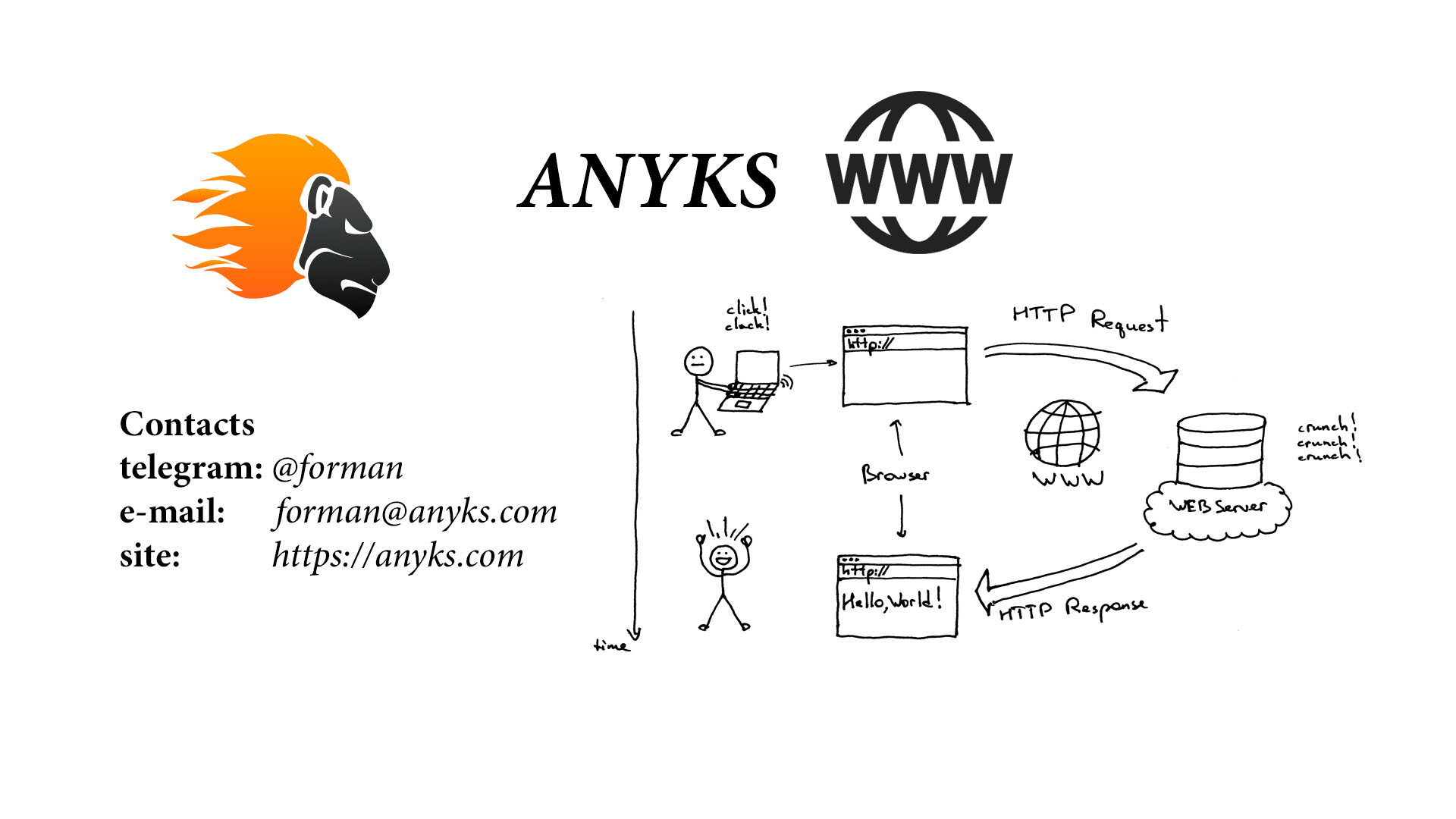
- HTTP / HTTPS: WEB - CLIENT / SERVER.
- WS / WSS: WebSocket - CLIENT / SERVER.
- Proxy: HTTP(S) / SOCKS5 PROXY - CLIENT / SERVER.
- Compress: GZIP / BZIP2 / ZSTD / LZ4 / LZMA / DEFLATE / BROTLI - compression support.
- Authentication: BASIC / DIGEST - authentication support.
- LZ4
- Zlib
- BZip2
- Brotli
- ZStandart
- Lempel–Ziv–Markov
- PCRE2
- A-NTS
- CityHash
- LibIconv
- LibIdn2
- NgHttp2
- GPerfTools
$ git clone --recursive https://gitflic.ru/project/anyks/awh.git$ sudo kldload sctp$ sudo apt-get install liblksctp-devel
$ sudo modprobe sctp
$ sudo sysctl -w net.sctp.auth_enable=1$ sudo apt install libsctp-dev
$ sudo modprobe sctp
$ sudo sysctl -w net.sctp.auth_enable=1$ sudo yum install lksctp-tools-devel
$ sudo modprobe sctp
$ sudo sysctl -w net.sctp.auth_enable=1$ sudo zypper install lksctp-tools-devel
$ sudo modprobe sctp
$ sudo sysctl -w net.sctp.auth_enable=1$ cd ./certs
$ ./certs.sh example.com$ ./build_third_party.sh --idn$ mkdir ./build
$ cd ./build
$ cmake \
-DCMAKE_BUILD_IDN=YES \
-DCMAKE_BUILD_TYPE=Release \
-DCMAKE_SHARED_BUILD_LIB=YES \
..
$ make$ pacman -Syuu
$ pacman -Ss cmake
$ pacman -S mingw64/mingw-w64-x86_64-cmake
$ pacman -S make
$ pacman -S curl
$ pacman -S wget
$ pacman -S mc
$ pacman -S gdb
$ pacman -S bash
$ pacman -S clang
$ pacman -S git
$ pacman -S autoconf
$ pacman -S --needed base-devel mingw-w64-x86_64-toolchain
$ pacman -S mingw-w64-x86_64-dlfcn$ ./build_third_party.sh$ mkdir ./build
$ cd ./build
$ cmake \
-G "MSYS Makefiles" \
-DCMAKE_BUILD_IDN=YES \
-DCMAKE_BUILD_TYPE=Release \
-DCMAKE_SYSTEM_NAME=Windows \
-DCMAKE_SHARED_BUILD_LIB=YES \
..
$ cmake --build .This path builds AWH with the Microsoft compiler. You need neither MSYS2 nor MinGW nor a
POSIX shell: batch scripts and CMake do all the work. At the end you have a library, a set of
headers and a FindAWH.cmake module, so your own Visual Studio project picks them up with
find_package(AWH).
The route is four steps, always in this order:
- Install the tools.
- Build the dependencies.
- Build the library.
- Install it and connect it to your project.
Steps 1 and 2 are done once per machine. Steps 3 and 4 you repeat when you want another configuration or another install location.
Why this path is kept apart from MinGW. The two compilers produce incompatible binaries,
and some dependencies decide the fate of their own headers while they are built: zlib, for
one, settles whether unistd.h exists. Mixing the results breaks the build silently, so each
toolchain keeps its own directory — MinGW uses third_party, Visual Studio uses
third_party-msvc. Both can live on the same machine, and neither disturbs the other.
Verified on Windows 10 build 19045, Visual Studio 18 Community, toolset 14.51.36231 (compiler 19.51.36260.0), x64.
One thing is required:
- Visual Studio 2019 or newer, with the "Desktop development with C++" workload. It gives you the compiler, the linker and the Windows SDK.
Three more tools help, but none of them is required:
- CMake. The script looks for it inside Visual Studio, then in
Program Files\CMake. Keep it elsewhere and name it by hand:set AWH_CMAKE=C:\tools\cmake.exe. - Ninja. Also looked for inside Visual Studio, then on the
PATH;set AWH_NINJA=...names it by hand. Without it the dependencies are built byNMake Makefilesin a single job — slower, but it works, and the script tells you it has fallen back. - GIT. Needed to check the submodules out and to apply the
lzmapatch. Without it the sources are built exactly as they lie on disk.
Visual Studio 18 ships neither CMake nor Ninja. On the machine this path was verified on, both were installed separately.
Any command prompt will do — cmd.exe from the Start menu is enough. The script finds Visual
Studio itself and sets up the compiler environment, so this step needs no developer prompt.
> git submodule update --init --recursive
> bat\build_third_party.bat
That one command builds all ten dependencies: A-NTS, zlib, bzip2, lz4, zstd, lzma, Brotli,
PCRE2, nghttp2 and the gperftools allocator. Everything lands in third_party-msvc — headers
in include, archives in lib. The version of each dependency is written in its own script
under bat\third_party, and those are the same versions the MinGW build takes from
build_third_party.sh.
Nine of the ten are libraries, and their archives are merged into one libdependence.lib.
The allocator is built after that merge and is deliberately left out of it; the reason is in
the notes at the end.
The script remembers what it has already built, so a second run costs almost nothing and rebuilds only what changed. Three arguments change that:
> bat\build_third_party.bat --rebuild
> bat\build_third_party.bat --clean
> bat\build_third_party.bat zlib--rebuild— build everything again, ignoring the marks.--clean— remove what has been built, leaving the sources alone.- a name such as
zlib— build that one dependency and nothing else.
Two details are worth knowing before you run it.
The architecture is taken from the machine, not from the environment. Under x86-64
emulation the environment variables describe the emulation, so an ARM64 machine would
silently get an x64 build. The script asks the system itself instead. To choose by hand:
set AWH_ARCH=x64, or set AWH_ARCH=arm64.
lzma needs a patch. The tag it is built from has an x64 branch in memcmplen.h that
calls a declaration the branch does not contain. bat\third_party\006_lzma.bat applies
patches\lzma\lzma.patch — the same patch the MinGW build uses. If GIT is missing, the script
says that the patch was not applied and that the x64 build may fail.
This step does need a developer prompt, because CMake has to find cl.exe on the PATH.
Open "x64 Native Tools Command Prompt for VS" (or the ARM64 one) from the Start menu, go to
the project directory and run:
> mkdir build
> cd build

> cmake -G Ninja ^
   -DCMAKE_BUILD_TYPE=Release ^
   -DCMAKE_C_COMPILER=cl.exe ^
   -DCMAKE_CXX_COMPILER=cl.exe ^
   ..

> cmake --build .
You get awh.lib in the build directory and the samples beside it. Two more things happen
by themselves at the end of the build:
- the dependency archives are merged into
awh.lib, so the library is self-contained and you do not have to list the dependencies when you link your program; FindAWH.cmakeis written tothird_party-msvc\cmake. It works out the install directory from its own location, so it carries no baked-in path and survives a move.
These are the same two steps the shell scripts perform under MinGW; here they are called as
their .bat counterparts.
One key does nothing on this path: -DCMAKE_BUILD_IDN. cmake\FindDependence.cmake looks
for libidn2 and iconv on the other systems only.
Still in the build directory:
> cmake --install . --prefix C:\awhThat copies the library, the headers, the certificates, the samples and the find module into
C:\awh. The path may contain spaces. The module reads its own location, so the copy works
from the new place without being regenerated.
Now point your project at that directory. Configure it with the same compiler and tell CMake where the module lives:
> cmake -G Ninja ^
   -DCMAKE_BUILD_TYPE=Release ^
   -DCMAKE_MODULE_PATH=C:/awh/cmake ^
   -DCMAKE_C_COMPILER=cl.exe ^
   -DCMAKE_CXX_COMPILER=cl.exe ^
   ..
Write forward slashes in -D values: CMake reads a backslash as an escape, and C:\awh
becomes an invalid escape sequence.
A minimal main.cpp and CMakeLists.txt are in "Example include AWH in your project" below.
Link against ${AWH_LIBRARIES}: the find module adds the Windows system libraries to that list
itself, so the only thing left to match is the runtime library the notes at the end describe.
Build it in its own directory so the two configurations do not overwrite each other. The only difference is one key:
> mkdir build-dll
> cd build-dll

> cmake -G Ninja ^
   -DCMAKE_BUILD_TYPE=Release ^
   -DCMAKE_SHARED_BUILD_LIB=YES ^
   -DCMAKE_C_COMPILER=cl.exe ^
   -DCMAKE_CXX_COMPILER=cl.exe ^
   ..

> cmake --build .
You get awh.dll and an import library named awh.lib; the samples link against the import
library. Installation puts the import library at lib\awh.lib and the DLL at
bin\awh\awh.dll.
Your project asks for the shared variant with -DCMAKE_SHARED_LIB_AWH=YES, and
find_package(AWH) then reports both AWH_LIBRARY and AWH_LIBRARY_DLL. Keep the DLL
reachable at run time — beside the executable or on the PATH — otherwise the program does
not start at all and Windows reports 0xC0000135.
Three differences from the static build are worth knowing:
- the dependencies are linked into the DLL itself, so the merge into
awh.libis skipped; - the exported symbols are collected by the build description
(
CMAKE_WINDOWS_EXPORT_ALL_SYMBOLS), not by declarations in the code: under native MSVCAWH_SHARED_EXPORTexpands to nothing, and you have nothing to decorate; - both configurations write the same
FindAWH.cmake, byte for byte, so building one does not spoil the other.
Use the same runtime library as AWH. The build compiles with the dynamic CRT — /MD, or
/MDd in a debug configuration — and that choice must be the same across the whole image. A
program linked against awh.lib has to use /MD too; mixing it with /MT fails at link time
with LNK2038: mismatch detected for 'RuntimeLibrary'. CMake chooses /MD by default, so an
ordinary CMake project needs no change, but a project that sets /MT by hand does. A machine
without Visual Studio needs the Visual C++ Redistributable for the matching toolset; awh.dll
carries the same requirement.
Link against ${AWH_LIBRARIES}, not ${AWH_LIBRARY}. The find module gives you AWH and,
in a debug configuration, the dependency archive, and on Windows it appends the system
libraries to that list itself: ws2_32, gdi32, crypt32, Iphlpapi, bcrypt, ole32,
shell32, uuid. Linking the single ${AWH_LIBRARY} file would leave them out.
The allocator stays out of the merged archive. libdependence.lib takes fourteen of the
seventeen archives that were built. tcmalloc_minimal.lib and common.lib are kept apart and
linked by name; the rest, low_level_alloc.lib among them, are kept out of the merge and are
not linked at all. Merging the allocator in would break the allocation interception: the
linker pulls an object out of an archive only when a symbol asks for it, and the interception
needs the object pulled whole. The build attaches it with /INCLUDE:__tcmalloc itself.
A static build proves less than it looks. Producing awh.lib involves no linking at all —
it is an archive of object files. A missing dependency therefore shows up only where something
is really linked: the samples, the DLL, or your program.
MSVC archives are not lib-prefixed. The dependencies land as nts.lib, zlibstatic.lib,
bz2_static.lib and so on. The merge step keeps the one prefixed name, libdependence.lib, so
that the same find modules serve both toolchains.
# Build installation package
$ ./dist/macos_make_installer.sh# Build installation package
$ ./dist/windows_make_installer.sh# Build installation package
$ ./dist/solaris_make_installer.sh
# Install AWH library
$ sudo pkg install -g awh_X.X.X-1_i86pc.p5p awh
# Registering installed components
$ sudo postinstall-awh# Build installation package
$ ./dist/freebsd_make_tar.sh
# Install AWH library
$ sudo tar -xzvf awh_X.X.X_FreeBSD_amd64.tar.gz -C /# Build installation package
$ ./dist/linux_make_deb.sh
# Install AWH library
sudo dpkg -i awh_X.X.X-X~X_amd64.deb# Build installation package
$ ./dist/linux_make_rpm.sh
# Install AWH library
sudo rpm -i glb-X.X.X-X.X_amd64.rpm// main.cpp
// cmake -DCMAKE_SHARED_LIB_AWH=YES ..
#include <iostream>
#include <awh/sys/lib.hpp>
int main(){
std::cout << "AWH Version: " << AWH_VERSION << std::endl;
return 0;
}cmake_minimum_required(VERSION 3.16)
project(my_app LANGUAGES CXX)
set(CMAKE_CXX_STANDARD 17)
find_package(AWH REQUIRED)
if (AWH_FOUND)
message(STATUS "AWH found: " ${AWH_LIBRARY} " " ${AWH_LIBRARY_DLL} " " ${AWH_INCLUDE_DIR})
else (AWH_FOUND)
message(FATAL_ERROR "AWH not found")
endif (AWH_FOUND)
add_executable(my_app main.cpp)
target_link_libraries(my_app PRIVATE ${AWH_LIBRARIES})$ mkdir ./build
$ cd ./build
$ cmake \
-DCMAKE_BUILD_IDN=YES \
-DCMAKE_BUILD_TYPE=Release \
-DCMAKE_SHARED_LIB_AWH=YES \
..
$ cmake --build .> mkdir build
> cd build
> cmake -G Ninja ^
-DCMAKE_BUILD_TYPE=Release ^
-DCMAKE_MODULE_PATH=C:/awh/cmake ^
-DCMAKE_C_COMPILER=cl.exe ^
-DCMAKE_CXX_COMPILER=cl.exe ^
..
> cmake --build .#include <awh/client/awh.hpp>
using namespace awh;
using namespace placeholders;
class WebClient {
private:
uint8_t _count;
private:
const fmk_t * _fmk;
const log_t * _log;
public:
void message(const int32_t sid, [[maybe_unused]] const uint64_t rid, const uint32_t code, const string & message){
if(code >= 300)
this->_log->print("Request failed: %u %s stream=%i", log_t::flag_t::WARNING, code, message.c_str(), sid);
}
void active(const client::web_t::mode_t mode, client::awh_t * awh){
this->_log->print("%s client", log_t::flag_t::INFO, (mode == client::web_t::mode_t::CONNECT ? "Connect" : "Disconnect"));
if(mode == client::web_t::mode_t::CONNECT){
uri_t uri(this->_fmk, this->_log);
client::web_t::request_t req1(this->_fmk, this->_log),
req2(this->_fmk, this->_log);
req1.method = web_t::method_t::GET;
req2.method = web_t::method_t::GET;
req1.url = uri.parse("/mac/");
req2.url = uri.parse("/iphone/");
awh->send(std::move(req1));
awh->send(std::move(req2));
}
}
void entity([[maybe_unused]] const int32_t sid, [[maybe_unused]] const uint64_t rid, [[maybe_unused]] const uint32_t code, [[maybe_unused]] const string & message, const vector <char> & entity, client::awh_t * awh){
this->_count++;
cout << "RESPONSE: " << string(entity.begin(), entity.end()) << endl;
if(this->_count == 2)
awh->stop();
}
void headers([[maybe_unused]] const int32_t sid, [[maybe_unused]] const uint64_t rid, [[maybe_unused]] const uint32_t code, [[maybe_unused]] const string & message, const unordered_multimap <string, string> & headers){
for(auto & header : headers)
cout << "HEADER: " << header.first << ": " << header.second << endl;
cout << endl;
}
void complete([[maybe_unused]] const int32_t sid, [[maybe_unused]] const uint64_t rid, [[maybe_unused]] const uint32_t code, [[maybe_unused]] const string & message, const vector <char> & entity, const unordered_multimap <string, string> & headers, client::awh_t * awh){
this->_count++;
for(auto & header : headers)
cout << "HEADER: " << header.first << ": " << header.second << endl;
cout << endl;
cout << "RESPONSE: " << string(entity.begin(), entity.end()) << endl;
if(this->_count == 2)
awh->stop();
}
public:
WebClient(const fmk_t * fmk, const log_t * log) : _fmk(fmk), _log(log) {}
};
int32_t main(int32_t argc, char * argv[]){
fmk_t fmk{};
log_t log(&fmk);
client::core_t core(&fmk, &log);
client::awh_t awh(&core, &fmk, &log);
WebClient executor(&fmk, &log);
core.proto(awh::engine_t::proto_t::HTTP2);
// core.proto(awh::engine_t::proto_t::HTTP1_1);
log.name("WEB Client");
log.format("%H:%M:%S %d.%m.%Y");
awh.mode({
client::web_t::flag_t::NOT_INFO,
client::web_t::flag_t::REDIRECTS,
client::web_t::flag_t::CONNECT_METHOD_ENABLE
});
node_t::ssl_t ssl;
ssl.verify = true;
ssl.ca = "./certs/ca.pem";
// ssl.key = "./certs/certificates/client-key.pem";
// ssl.cert = "./certs/certificates/client-cert.pem";
core.ssl(ssl);
// awh.user("user", "password");
// awh.authType(auth_t::type_t::BASIC);
// awh.authType(auth_t::type_t::DIGEST, auth_t::hash_t::MD5);
// awh.proxy("http://user:password@host.com:port");
// awh.proxy("https://user:password@host.com:port");
// awh.proxy("socks5://user:password@host.com:port");
// awh.proxy(client::scheme_t::work_t::ALLOW);
// awh.proxy(client::scheme_t::work_t::DISALLOW);
// awh.authTypeProxy(auth_t::type_t::BASIC);
// awh.authTypeProxy(auth_t::type_t::DIGEST, auth_t::hash_t::MD5);
/*
awh.compressors({
http_t::compressor_t::ZSTD,
http_t::compressor_t::BROTLI,
http_t::compressor_t::GZIP,
http_t::compressor_t::DEFLATE
});
*/
awh.on <void (const client::web_t::mode_t)> ("active", &WebClient::active, &executor, _1, &awh);
awh.on <void (const int32_t, const uint64_t, const uint32_t, const string &)> ("response", &WebClient::message, &executor, _1, _2, _3, _4);
// awh.on <void (const int32_t, const uint64_t, const uint32_t, const string &, const unordered_multimap <string, string> &)> ("headers", &WebClient::headers, &executor, _1, _2, _3, _4, _5);
// awh.on <void (const int32_t, const uint64_t, const uint32_t, const string &, const vector <char> &)> ("entity", &WebClient::entity, &executor, _1, _2, _3, _4, _5, &awh);
awh.on <void (const int32_t, const uint64_t, const uint32_t, const string &, const vector <char> &, const unordered_multimap <string, string> &)> ("complete", &WebClient::complete, &executor, _1, _2, _3, _4, _5, _6, &awh);
awh.init("https://apple.com");
awh.start();
return EXIT_SUCCESS;
}#include <awh/client/awh.hpp>
using namespace awh;
int32_t main(int32_t argc, char * argv[]){
fmk_t fmk{};
log_t log(&fmk);
uri_t uri(&fmk, &log);
client::core_t core(&fmk, &log);
client::awh_t awh(&core, &fmk, &log);
core.proto(awh::engine_t::proto_t::HTTP2);
// core.proto(awh::engine_t::proto_t::HTTP1_1);
log.name("WEB Client");
log.format("%H:%M:%S %d.%m.%Y");
awh.mode({
client::web_t::flag_t::NOT_INFO,
client::web_t::flag_t::REDIRECTS,
client::web_t::flag_t::CONNECT_METHOD_ENABLE
});
node_t::ssl_t ssl;
ssl.verify = true;
ssl.ca = "./certs/ca.pem";
// ssl.key = "./certs/certificates/client-key.pem";
// ssl.cert = "./certs/certificates/client-cert.pem";
core.ssl(ssl);
// awh.user("user", "password");
// awh.authType(auth_t::type_t::BASIC);
// awh.authType(auth_t::type_t::DIGEST, auth_t::hash_t::MD5);
// awh.proxy("http://user:password@host.com:port");
// awh.proxy("https://user:password@host.com:port");
// awh.proxy("socks5://user:password@host.com:port");
// awh.proxy(client::scheme_t::work_t::ALLOW);
// awh.proxy(client::scheme_t::work_t::DISALLOW);
// awh.authTypeProxy(auth_t::type_t::BASIC);
// awh.authTypeProxy(auth_t::type_t::DIGEST, auth_t::hash_t::MD5);
/*
awh.compressors({
http_t::compressor_t::ZSTD,
http_t::compressor_t::BROTLI,
http_t::compressor_t::GZIP,
http_t::compressor_t::DEFLATE
});
*/
uri_t::url_t url = uri.parse("https://apple.com/ru/mac");
const auto & body = awh.GET(url);
if(!body.empty())
cout << "RESPONSE: " << string(body.begin(), body.end()) << endl;
return EXIT_SUCCESS;
}#include <awh/server/awh.hpp>
using namespace awh;
using namespace placeholders;
class WebServer {
private:
hash_t _hash;
private:
const fmk_t * _fmk;
const log_t * _log;
private:
awh::web_t::method_t _method;
public:
string password(const uint64_t bid, const string & login){
this->_log->print("USER: %s, PASS: %s, ID: %zu", log_t::flag_t::INFO, login.c_str(), "password", bid);
return "password";
}
bool auth(const uint64_t bid, const string & login, const string & password){
this->_log->print("USER: %s, PASS: %s, ID: %zu", log_t::flag_t::INFO, login.c_str(), password.c_str(), bid);
return true;
}
public:
bool accept(const string & ip, const string & mac, const uint32_t port){
this->_log->print("ACCEPT: IP=%s, MAC=%s, PORT=%d", log_t::flag_t::INFO, ip.c_str(), mac.c_str(), port);
return true;
}
void launched(const string & host, const uint32_t port){
this->_log->print("Launched: HOST=%s, PORT=%d", log_t::flag_t::INFO, host.c_str(), port);
}
void active([[maybe_unused]] const uint64_t bid, const server::web_t::mode_t mode){
this->_log->print("%s client", log_t::flag_t::INFO, (mode == server::web_t::mode_t::CONNECT ? "Connect" : "Disconnect"));
}
void handshake(const int32_t sid, const uint64_t bid, const server::web_t::agent_t agent, server::awh_t * awh){
if((this->_method == awh::web_t::method_t::GET) && (agent == server::web_t::agent_t::HTTP)){
cout << "URL: " << awh->parser(sid, bid)->request().url << endl << endl;
const string body = "<html>\n<head>\n<title>Hello World!</title>\n</head>\n<body>\n"
"<h1>\"Hello, World!\" program</h1>\n"
"<div>\nFrom Wikipedia, the free encyclopedia<br>\n"
"(Redirected from Hello, world!)<br>\n"
"Jump to navigationJump to search<br>\n"
"<strong>\"Hello World\"</strong> redirects here. For other uses, see Hello World (disambiguation).<br>\n"
"A <strong>\"Hello, World!\"</strong> program generally is a computer program that outputs or displays the message \"Hello, World!\".<br>\n"
"Such a program is very simple in most programming languages, and is often used to illustrate the basic syntax of a programming language. It is often the first program written by people learning to code. It can also be used as a sanity test to make sure that computer software intended to compile or run source code is correctly installed, and that the operator understands how to use it.\n"
"</div>\n</body>\n</html>\n";
if(awh->proto(bid) == engine_t::proto_t::HTTP2){
vector <pair <string, string>> headers = {
{":method", "GET"},
{":scheme", "https"},
{":path", "/stylesheets/screen.css"},
{":authority", "example.com"},
{"accept-encoding", "gzip, deflate"}
};
if(awh->push2(sid, bid, headers, awh::http2_t::flag_t::NONE) < 0)
this->_log->print("Push message is not send", log_t::flag_t::WARNING);
}
if(awh->trailers(sid, bid)){
awh->trailer(sid, bid, "Goga", "Hello");
awh->trailer(sid, bid, "Hello", "World");
awh->trailer(sid, bid, "Anyks", "Best of the best");
awh->trailer(sid, bid, "Checksum", this->_hash.hashing <string> (body, hash_t::type_t::MD5));
}
awh->send(sid, bid, 200, "OK", vector <char> (body.begin(), body.end()));
}
}
void request(const int32_t sid, const uint64_t bid, const awh::web_t::method_t method, const uri_t::url_t & url, server::awh_t * awh){
this->_method = method;
if(!url.empty() && (!url.path.empty() && url.path.back().compare("favicon.ico") == 0))
awh->send(sid, bid, 404);
}
void headers([[maybe_unused]] const int32_t sid, [[maybe_unused]] const uint64_t bid, [[maybe_unused]] const awh::web_t::method_t method, [[maybe_unused]] const uri_t::url_t & url, const unordered_multimap <string, string> & headers){
for(auto & header : headers)
cout << "HEADER: " << header.first << ": " << header.second << endl;
}
void entity(const int32_t sid, const uint64_t bid, [[maybe_unused]] const awh::web_t::method_t method, const uri_t::url_t & url, const vector <char> & entity, server::awh_t * awh){
cout << "URL: " << url << endl << endl;
cout << "BODY: " << string(entity.begin(), entity.end()) << endl;
awh->send(sid, bid, 200, "OK", entity, {{"Connection", "close"}});
}
void complete(const int32_t sid, const uint64_t bid, [[maybe_unused]] const awh::web_t::method_t method, const uri_t::url_t & url, const vector <char> & entity, const unordered_multimap <string, string> & headers, server::awh_t * awh){
for(auto & header : headers)
cout << "HEADER: " << header.first << ": " << header.second << endl;
cout << "URL: " << url << endl << endl;
if(!entity.empty()){
cout << "BODY: " << string(entity.begin(), entity.end()) << endl;
awh->send(sid, bid, 200, "OK", entity, {{"Connection", "close"}});
}
}
public:
WebServer(const fmk_t * fmk, const log_t * log) : _hash(log), _fmk(fmk), _log(log), _method(awh::web_t::method_t::NONE) {}
};
int32_t main(int32_t argc, char * argv[]){
fmk_t fmk;
log_t log(&fmk);
server::core_t core(&fmk, &log);
server::awh_t awh(&core, &fmk, &log);
WebServer executor(&fmk, &log);
log.name("WEB Server");
log.format("%H:%M:%S %d.%m.%Y");
core.sonet(awh::scheme_t::sonet_t::TLS);
core.proto(awh::engine_t::proto_t::HTTP2);
// core.proto(awh::engine_t::proto_t::HTTP1_1);
core.cluster(awh::scheme_t::mode_t::ENABLED);
node_t::ssl_t ssl;
ssl.verify = false;
ssl.key = "./certs/certificates/server-key.pem";
ssl.cert = "./certs/certificates/server-cert.pem";
core.ssl(ssl);
core.transferRule(server::core_t::transfer_t::ASYNC);
// awh.authType(auth_t::type_t::BASIC);
awh.authType(auth_t::type_t::DIGEST, auth_t::hash_t::MD5);
awh.init(2222, "127.0.0.1", {
awh::http_t::compressor_t::ZSTD,
awh::http_t::compressor_t::BROTLI,
awh::http_t::compressor_t::GZIP,
awh::http_t::compressor_t::DEFLATE,
});
/*
awh.init("anyks", {
awh::http_t::compressor_t::ZSTD,
awh::http_t::compressor_t::BROTLI,
awh::http_t::compressor_t::GZIP,
awh::http_t::compressor_t::DEFLATE,
});
*/
// awh.addOrigin("example.net");
// awh.addAltSvc("example.net", "h2=\":2222\"");
// awh.addAltSvc("example.com", "h2=\":8000\"");
awh.on <void (const string &, const uint32_t)> ("launched", &WebServer::launched, &executor, _1, _2);
awh.on <string (const uint64_t, const string &)> ("extractPassword", &WebServer::password, &executor, _1, _2);
awh.on <bool (const uint64_t, const string &, const string &)> ("checkPassword", &WebServer::auth, &executor, _1, _2, _3);
awh.on <void (const uint64_t, const server::web_t::mode_t)> ("active", &WebServer::active, &executor, _1, _2);
awh.on <bool (const string &, const string &, const uint32_t)> ("accept", &WebServer::accept, &executor, _1, _2, _3);
awh.on <void (const int32_t, const uint64_t, const server::web_t::agent_t)> ("handshake", &WebServer::handshake, &executor, _1, _2, _3, &awh);
awh.on <void (const int32_t, const uint64_t, const awh::web_t::method_t, const uri_t::url_t &)> ("request", &WebServer::request, &executor, _1, _2, _3, _4, &awh);
// awh.on <void (const int32_t, const uint64_t, const awh::web_t::method_t, const uri_t::url_t &, const unordered_multimap <string, string> &)> ("headers", &WebServer::headers, &executor, _1, _2, _3, _4, _5);
// awh.on <void (const int32_t, const uint64_t, const awh::web_t::method_t, const uri_t::url_t &, const vector <char> &)> ("entity", &WebServer::entity, &executor, _1, _2, _3, _4, _5, &awh);
awh.on <void (const int32_t, const uint64_t, const awh::web_t::method_t, const uri_t::url_t &, const vector <char> &, const unordered_multimap <string, string> &)> ("complete", &WebServer::complete, &executor, _1, _2, _3, _4, _5, _6, &awh);
awh.start();
return EXIT_SUCCESS;
}#include <awh/client/ws.hpp>
using namespace awh;
using namespace placeholders;
class Executor {
private:
const fmk_t * _fmk;
const log_t * _log;
public:
void status(const awh::core_t::status_t status){
switch(static_cast <uint8_t> (status)){
case static_cast <uint8_t> (awh::core_t::status_t::START):
this->_log->print("START", log_t::flag_t::INFO);
break;
case static_cast <uint8_t> (awh::core_t::status_t::STOP):
this->_log->print("STOP", log_t::flag_t::INFO);
break;
}
}
void handshake([[maybe_unused]] const int32_t sid, [[maybe_unused]] const uint64_t rid, const client::web_t::agent_t agent, client::websocket_t * ws){
if(agent == client::web_t::agent_t::WEBSOCKET){
this->_log->print("Handshake", log_t::flag_t::INFO);
const string query = "Hello World!!!";
ws->sendMessage(vector <char> (query.begin(), query.end()));
}
}
public:
void error(const uint32_t code, const string & mess){
this->_log->print("%s [%u]", log_t::flag_t::CRITICAL, mess.c_str(), code);
}
void message(const vector <char> & buffer, const bool utf8, client::websocket_t * ws){
string subprotocol = "";
const auto subprotocols = ws->subprotocols();
if(!subprotocols.empty())
subprotocol = (* subprotocols.begin());
if(utf8){
cout << "MESSAGE: " << string(buffer.begin(), buffer.end()) << endl;
cout << "SUB PROTOCOL: " << subprotocol << endl;
}
}
public:
Executor(const fmk_t * fmk, const log_t * log) : _fmk(fmk), _log(log) {}
};
int32_t main(int32_t argc, char * argv[]){
fmk_t fmk;
log_t log(&fmk);
client::core_t core(&fmk, &log);
client::websocket_t ws(&core, &fmk, &log);
Executor executor(&fmk, &log);
log.name("WebSocket Client");
log.format("%H:%M:%S %d.%m.%Y");
ws.mode({
client::web_t::flag_t::ALIVE,
client::web_t::flag_t::REDIRECTS,
client::web_t::flag_t::TAKEOVER_CLIENT,
client::web_t::flag_t::TAKEOVER_SERVER,
client::web_t::flag_t::CONNECT_METHOD_ENABLE
});
core.sonet(awh::scheme_t::sonet_t::TLS);
core.proto(awh::engine_t::proto_t::HTTP2);
// core.proto(awh::engine_t::proto_t::HTTP1_1);
node_t::ssl_t ssl;
ssl.verify = false;
ssl.key = "./certs/certificates/client-key.pem";
ssl.cert = "./certs/certificates/client-cert.pem";
core.ssl(ssl);
// ws.proxy("http://user:password@host.com:port");
// ws.proxy("https://user:password@host.com:port");
// ws.proxy("socks5://user:password@host.com:port");
// ws.proxy(client::scheme_t::work_t::ALLOW);
// ws.proxy(client::scheme_t::work_t::DISALLOW);
// ws.authTypeProxy(auth_t::type_t::BASIC);
// ws.authTypeProxy(auth_t::type_t::DIGEST, auth_t::hash_t::MD5);
ws.user("user", "password");
// ws.authType(awh::auth_t::type_t::BASIC);
ws.authType(awh::auth_t::type_t::DIGEST, awh::auth_t::hash_t::MD5);
ws.init("wss://127.0.0.1:2222", {awh::http_t::compressor_t::DEFLATE});
ws.subprotocols({"test2", "test8", "test9"});
// ws.extensions({{"test1", "test2", "test3"},{"good1", "good2", "good3"}});
ws.on <void (const awh::core_t::status_t)> ("status", &Executor::status, &executor, _1);
ws.on <void (const uint32_t, const string &)> ("errorWebsocket", &Executor::error, &executor, _1, _2);
ws.on <void (const vector <char> &, const bool)> ("messageWebsocket", &Executor::message, &executor, _1, _2, &ws);
ws.on <void (const int32_t, const uint64_t, const client::web_t::agent_t)> ("handshake", &Executor::handshake, &executor, _1, _2, _3, &ws);
ws.start();
return EXIT_SUCCESS;
}#include <awh/server/ws.hpp>
using namespace awh;
using namespace placeholders;
class Executor {
private:
const fmk_t * _fmk;
const log_t * _log;
public:
string password(const uint64_t bid, const string & login){
this->_log->print("USER: %s, PASS: %s, ID: %zu", log_t::flag_t::INFO, login.c_str(), "password", bid);
return "password";
}
bool auth(const uint64_t bid, const string & login, const string & password){
this->_log->print("USER: %s, PASS: %s, ID: %zu", log_t::flag_t::INFO, login.c_str(), password.c_str(), bid);
return true;
}
public:
bool accept(const string & ip, const string & mac, const uint32_t port){
this->_log->print("ACCEPT: IP=%s, MAC=%s, PORT=%d", log_t::flag_t::INFO, ip.c_str(), mac.c_str(), port);
return true;
}
void launched(const string & host, const uint32_t port){
this->_log->print("Launched: HOST=%s, PORT=%d", log_t::flag_t::INFO, host.c_str(), port);
}
void active([[maybe_unused]] const uint64_t bid, const server::web_t::mode_t mode){
switch(static_cast <uint8_t> (mode)){
case static_cast <uint8_t> (server::web_t::mode_t::CONNECT):
this->_log->print("CONNECT", log_t::flag_t::INFO);
break;
case static_cast <uint8_t> (server::web_t::mode_t::DISCONNECT):
this->_log->print("DISCONNECT", log_t::flag_t::INFO);
break;
}
}
void error([[maybe_unused]] const uint64_t bid, const uint32_t code, const string & mess){
this->_log->print("%s [%u]", log_t::flag_t::CRITICAL, mess.c_str(), code);
}
void message(const uint64_t bid, const vector <char> & buffer, const bool text, server::websocket_t * ws){
if(!buffer.empty()){
string subprotocol = "";
const auto subprotocols = ws->subprotocols(bid);
if(!subprotocols.empty())
subprotocol = (* subprotocols.begin());
this->_log->print("Message: %s [%s]", log_t::flag_t::INFO, string(buffer.begin(), buffer.end()).c_str(), subprotocol.c_str());
ws->sendMessage(bid, buffer, text);
}
}
void headers([[maybe_unused]] const int32_t sid, [[maybe_unused]] const uint64_t bid, [[maybe_unused]] const awh::web_t::method_t method, const uri_t::url_t & url, const unordered_multimap <string, string> & headers){
uri_t uri(this->_fmk, this->_log);
this->_log->print("REQUEST ID=%zu URL=%s", log_t::flag_t::INFO, bid, uri.url(url).c_str());
for(auto & header : headers)
cout << "HEADER: " << header.first << ": " << header.second << endl;
}
public:
Executor(const fmk_t * fmk, const log_t * log) : _fmk(fmk), _log(log) {}
};
int32_t main(int32_t argc, char * argv[]){
fmk_t fmk;
log_t log(&fmk);
server::core_t core(&fmk, &log);
server::websocket_t ws(&core, &fmk, &log);
Executor executor(&fmk, &log);
log.name("WebSocket Server");
log.format("%H:%M:%S %d.%m.%Y");
ws.mode({
server::web_t::flag_t::TAKEOVER_CLIENT,
server::web_t::flag_t::TAKEOVER_SERVER
});
core.sonet(awh::scheme_t::sonet_t::TLS);
core.proto(awh::engine_t::proto_t::HTTP2);
// core.proto(awh::engine_t::proto_t::HTTP1_1);
core.cluster(awh::scheme_t::mode_t::ENABLED);
node_t::ssl_t ssl;
ssl.verify = false;
ssl.key = "./certs/certificates/server-key.pem";
ssl.cert = "./certs/certificates/server-cert.pem";
core.ssl(ssl);
core.transferRule(server::core_t::transfer_t::ASYNC);
ws.subprotocols({"test1", "test2", "test3"});
// ws.authType(awh::auth_t::type_t::BASIC);
ws.authType(awh::auth_t::type_t::DIGEST, awh::auth_t::hash_t::MD5);
// ws.init("anyks", {awh::http_t::compressor_t::DEFLATE});
// ws.init(2222, "", {awh::http_t::compressor_t::DEFLATE});
ws.init(2222, "127.0.0.1", {awh::http_t::compressor_t::DEFLATE});
ws.on <void (const string &, const uint32_t)> ("launched", &Executor::launched, &executor, _1, _2);
ws.on <string (const uint64_t, const string &)> ("extractPassword", &Executor::password, &executor, _1, _2);
ws.on <bool (const uint64_t, const string &, const string &)> ("checkPassword", &Executor::auth, &executor, _1, _2, _3);
ws.on <bool (const string &, const string &, const uint32_t)> ("accept", &Executor::accept, &executor, _1, _2, _3);
ws.on <void (const uint64_t, const server::web_t::mode_t)> ("active", &Executor::active, &executor, _1, _2);
ws.on <void (const uint64_t, const uint32_t, const string &)> ("errorWebsocket", &Executor::error, &executor, _1, _2, _3);
ws.on <void (const uint64_t, const vector <char> &, const bool)> ("messageWebsocket", &Executor::message, &executor, _1, _2, _3, &ws);
ws.on <void (const int32_t, const uint64_t, const awh::web_t::method_t, const uri_t::url_t &, const unordered_multimap <string, string> &)> ("headers", &Executor::headers, &executor, _1, _2, _3, _4, _5);
ws.start();
return EXIT_SUCCESS;
}#include <awh/server/awh.hpp>
using namespace awh;
using namespace placeholders;
class WebServer {
private:
hash_t _hash;
private:
const fmk_t * _fmk;
const log_t * _log;
private:
awh::web_t::method_t _method;
public:
string password(const uint64_t bid, const string & login){
this->_log->print("USER: %s, PASS: %s, ID: %zu", log_t::flag_t::INFO, login.c_str(), "password", bid);
return "password";
}
bool auth(const uint64_t bid, const string & login, const string & password){
this->_log->print("USER: %s, PASS: %s, ID: %zu", log_t::flag_t::INFO, login.c_str(), password.c_str(), bid);
return true;
}
public:
bool accept(const string & ip, const string & mac, const uint32_t port){
this->_log->print("ACCEPT: IP=%s, MAC=%s, PORT=%d", log_t::flag_t::INFO, ip.c_str(), mac.c_str(), port);
return true;
}
void launched(const string & host, const uint32_t port){
this->_log->print("Launched: HOST=%s, PORT=%d", log_t::flag_t::INFO, host.c_str(), port);
}
void active([[maybe_unused]] const uint64_t bid, const server::web_t::mode_t mode){
this->_log->print("%s client", log_t::flag_t::INFO, (mode == server::web_t::mode_t::CONNECT ? "Connect" : "Disconnect"));
}
void error([[maybe_unused]] const uint64_t bid, const uint32_t code, const string & mess){
this->_log->print("%s [%u]", log_t::flag_t::CRITICAL, mess.c_str(), code);
}
void message(const uint64_t bid, const vector <char> & buffer, const bool text, server::awh_t * awh){
if(!buffer.empty()){
string subprotocol = "";
const auto subprotocols = awh->subprotocols(bid);
if(!subprotocols.empty())
subprotocol = (* subprotocols.begin());
this->_log->print("Message: %s [%s]", log_t::flag_t::INFO, string(buffer.begin(), buffer.end()).c_str(), subprotocol.c_str());
awh->sendMessage(bid, buffer, text);
}
}
void handshake(const int32_t sid, const uint64_t bid, const server::web_t::agent_t agent, server::awh_t * awh){
if((this->_method == awh::web_t::method_t::GET) && (agent == server::web_t::agent_t::HTTP)){
cout << " URL: " << awh->parser(sid, bid)->request().url << endl;
const string body = "<html>\n<head>\n<title>Hello World!</title>\n</head>\n<body>\n"
"<h1>\"Hello, World!\" program</h1>\n"
"<div>\nFrom Wikipedia, the free encyclopedia<br>\n"
"(Redirected from Hello, world!)<br>\n"
"Jump to navigationJump to search<br>\n"
"<strong>\"Hello World\"</strong> redirects here. For other uses, see Hello World (disambiguation).<br>\n"
"A <strong>\"Hello, World!\"</strong> program generally is a computer program that outputs or displays the message \"Hello, World!\".<br>\n"
"Such a program is very simple in most programming languages, and is often used to illustrate the basic syntax of a programming language. It is often the first program written by people learning to code. It can also be used as a sanity test to make sure that computer software intended to compile or run source code is correctly installed, and that the operator understands how to use it.\n"
"</div>\n</body>\n</html>\n";
if(awh->trailers(sid, bid)){
awh->trailer(sid, bid, "Goga", "Hello");
awh->trailer(sid, bid, "Hello", "World");
awh->trailer(sid, bid, "Anyks", "Best of the best");
awh->trailer(sid, bid, "Checksum", this->_hash.hashing <string> (body, hash_t::type_t::MD5));
}
awh->send(sid, bid, 200, "OK", vector <char> (body.begin(), body.end()));
}
}
void request(const int32_t sid, const uint64_t bid, const awh::web_t::method_t method, const uri_t::url_t & url, server::awh_t * awh){
this->_method = method;
if(!url.empty() && (!url.path.empty() && url.path.back().compare("favicon.ico") == 0))
awh->send(sid, bid, 404);
}
void headers([[maybe_unused]] const int32_t sid, [[maybe_unused]] const uint64_t bid, [[maybe_unused]] const awh::web_t::method_t method, [[maybe_unused]] const uri_t::url_t & url, const unordered_multimap <string, string> & headers){
for(auto & header : headers)
cout << "HEADER: " << header.first << ": " << header.second << endl;
}
void entity(const int32_t sid, const uint64_t bid, [[maybe_unused]] const awh::web_t::method_t method, const uri_t::url_t & url, const vector <char> & entity, server::awh_t * awh){
cout << "URL: " << url << endl << endl;
cout << "BODY: " << string(entity.begin(), entity.end()) << endl;
awh->send(sid, bid, 200, "OK", entity, {{"Connection", "close"}});
}
void complete(const int32_t sid, const uint64_t bid, [[maybe_unused]] const awh::web_t::method_t method, const uri_t::url_t & url, const vector <char> & entity, const unordered_multimap <string, string> & headers, server::awh_t * awh){
for(auto & header : headers)
cout << "HEADER: " << header.first << ": " << header.second << endl;
cout << "URL: " << url << endl << endl;
if(!entity.empty()){
cout << "BODY: " << string(entity.begin(), entity.end()) << endl;
awh->send(sid, bid, 200, "OK", entity, {{"Connection", "close"}});
}
}
public:
WebServer(const fmk_t * fmk, const log_t * log) : _hash(log), _fmk(fmk), _log(log), _method(awh::web_t::method_t::NONE) {}
};
int32_t main(int32_t argc, char * argv[]){
fmk_t fmk;
log_t log(&fmk);
server::core_t core(&fmk, &log);
server::awh_t awh(&core, &fmk, &log);
WebServer executor(&fmk, &log);
log.name("WEB Server");
log.format("%H:%M:%S %d.%m.%Y");
awh.mode({
server::web_t::flag_t::TAKEOVER_CLIENT,
server::web_t::flag_t::TAKEOVER_SERVER,
server::web_t::flag_t::WEBSOCKET_ENABLE,
server::web_t::flag_t::CONNECT_METHOD_ENABLE
});
core.sonet(awh::scheme_t::sonet_t::TLS);
core.proto(awh::engine_t::proto_t::HTTP2);
// core.proto(awh::engine_t::proto_t::HTTP1_1);
core.cluster(awh::scheme_t::mode_t::ENABLED);
node_t::ssl_t ssl;
ssl.verify = false;
ssl.key = "./certs/certificates/server-key.pem";
ssl.cert = "./certs/certificates/server-cert.pem";
core.ssl(ssl);
core.transferRule(server::core_t::transfer_t::ASYNC);
// awh.authType(auth_t::type_t::BASIC);
awh.authType(auth_t::type_t::DIGEST, auth_t::hash_t::MD5);
awh.init(2222, "127.0.0.1", {
awh::http_t::compressor_t::ZSTD,
awh::http_t::compressor_t::BROTLI,
awh::http_t::compressor_t::GZIP,
awh::http_t::compressor_t::DEFLATE,
});
/*
awh.init("anyks", {
awh::http_t::compressor_t::ZSTD,
awh::http_t::compressor_t::BROTLI,
awh::http_t::compressor_t::GZIP,
awh::http_t::compressor_t::DEFLATE,
});
*/
awh.addOrigin("example.net");
awh.addAltSvc("example.net", "h2=\":2222\"");
awh.addAltSvc("example.com", "h2=\":8000\"");
awh.subprotocols({"test1", "test2", "test3"});
awh.on <void (const string &, const uint32_t)> ("launched", &WebServer::launched, &executor, _1, _2);
awh.on <string (const uint64_t, const string &)> ("extractPassword", &WebServer::password, &executor, _1, _2);
awh.on <bool (const uint64_t, const string &, const string &)> ("checkPassword", &WebServer::auth, &executor, _1, _2, _3);
awh.on <void (const uint64_t, const server::web_t::mode_t)> ("active", &WebServer::active, &executor, _1, _2);
awh.on <bool (const string &, const string &, const uint32_t)> ("accept", &WebServer::accept, &executor, _1, _2, _3);
awh.on <void (const uint64_t, const uint32_t, const string &)> ("errorWebsocket", &WebServer::error, &executor, _1, _2, _3);
awh.on <void (const uint64_t, const vector <char> &, const bool)> ("messageWebsocket", &WebServer::message, &executor, _1, _2, _3, &awh);
awh.on <void (const int32_t, const uint64_t, const server::web_t::agent_t)> ("handshake", &WebServer::handshake, &executor, _1, _2, _3, &awh);
awh.on <void (const int32_t, const uint64_t, const awh::web_t::method_t, const uri_t::url_t &)> ("request", &WebServer::request, &executor, _1, _2, _3, _4, &awh);
// awh.on <void (const int32_t, const uint64_t, const awh::web_t::method_t, const uri_t::url_t &, const vector <char> &)> ("entity", &WebServer::entity, &executor, _1, _2, _3, _4, _5, &awh);
// awh.on <void (const int32_t, const uint64_t, const awh::web_t::method_t, const uri_t::url_t &, const unordered_multimap <string, string> &)> ("headers", &WebServer::headers, &executor, _1, _2, _3, _4, _5);
awh.on <void (const int32_t, const uint64_t, const awh::web_t::method_t, const uri_t::url_t &, const vector <char> &, const unordered_multimap <string, string> &)> ("complete", &WebServer::complete, &executor, _1, _2, _3, _4, _5, _6, &awh);
awh.start();
return EXIT_SUCCESS;
}#include <awh/server/proxy.hpp>
using namespace awh;
using namespace placeholders;
class Proxy {
private:
log_t * _log;
public:
string password([[maybe_unused]] const uint64_t bid, const string & login){
this->_log->print("USER: %s, PASS: %s", log_t::flag_t::INFO, login.c_str(), "password");
return "password";
}
bool auth([[maybe_unused]] const uint64_t bid, const string & login, const string & password){
this->_log->print("USER: %s, PASS: %s", log_t::flag_t::INFO, login.c_str(), password.c_str());
return true;
}
public:
bool accept(const string & ip, const string & mac, const uint32_t port){
this->_log->print("ACCEPT: IP=%s, MAC=%s, PORT=%d", log_t::flag_t::INFO, ip.c_str(), mac.c_str(), port);
return true;
}
void active([[maybe_unused]] const uint64_t bid, const server::proxy_t::broker_t broker, const server::web_t::mode_t mode){
switch(static_cast <uint8_t> (broker)){
case static_cast <uint8_t> (server::proxy_t::broker_t::CLIENT):
this->_log->print("%s client", log_t::flag_t::INFO, (mode == server::web_t::mode_t::CONNECT ? "Connect" : "Disconnect"));
break;
case static_cast <uint8_t> (server::proxy_t::broker_t::SERVER):
this->_log->print("%s server", log_t::flag_t::INFO, (mode == server::web_t::mode_t::CONNECT ? "Connect" : "Disconnect"));
break;
}
}
public:
Proxy(log_t * log) : _log(log) {}
};
int32_t main(int32_t argc, char * argv[]){
fmk_t fmk;
log_t log(&fmk);
Proxy executor(&log);
server::proxy_t proxy(&fmk, &log);
log.name("Proxy Server");
log.format("%H:%M:%S %d.%m.%Y");
proxy.cluster(awh::scheme_t::mode_t::ENABLED);
node_t::ssl_t ssl;
ssl.verify = false;
ssl.ca = "./certs/ca.pem";
ssl.key = "./certs/certificates/server-key.pem";
ssl.cert = "./certs/certificates/server-cert.pem";
proxy.ssl(ssl);
proxy.mode({
server::proxy_t::flag_t::SYNCPROTO,
server::proxy_t::flag_t::REDIRECTS,
server::proxy_t::flag_t::CONNECT_METHOD_SERVER_ENABLE
});
proxy.hosts(server::proxy_t::broker_t::CLIENT, "/etc/hosts");
// proxy.authType(server::proxy_t::broker_t::SERVER, auth_t::type_t::BASIC);
// proxy.authType(server::proxy_t::broker_t::SERVER, auth_t::type_t::DIGEST, auth_t::hash_t::SHA512);
proxy.authType(server::proxy_t::broker_t::SERVER, auth_t::type_t::DIGEST, auth_t::hash_t::MD5);
// proxy.init("anyks", http_t::compressor_t::GZIP);
// proxy.init(2222, "", http_t::compressor_t::GZIP);
proxy.init(2222, "127.0.0.1", http_t::compressor_t::GZIP);
proxy.on <string (const uint64_t, const string &)> ("extractPassword", &Proxy::password, &executor, _1, _2);
proxy.on <bool (const uint64_t, const string &, const string &)> ("checkPassword", &Proxy::auth, &executor, _1, _2, _3);
proxy.on <bool (const string &, const string &, const uint32_t)> ("accept", &Proxy::accept, &executor, _1, _2, _3);
proxy.on <void (const uint64_t, const server::proxy_t::broker_t, const server::web_t::mode_t)> ("active", &Proxy::active, &executor, _1, _2, _3);
proxy.start();
return EXIT_SUCCESS;
}#include <awh/server/socks5.hpp>
using namespace awh;
using namespace server;
using namespace placeholders;
class Proxy {
private:
const fmk_t * _fmk;
const log_t * _log;
public:
bool auth(const uint64_t bid, const string & login, const string & password){
this->_log->print("USER: %s, PASS: %s, ID: %zu", log_t::flag_t::INFO, login.c_str(), password.c_str(), bid);
return true;
}
public:
bool accept(const string & ip, const string & mac, const uint32_t port){
this->_log->print("ACCEPT: IP=%s, MAC=%s, PORT=%d", log_t::flag_t::INFO, ip.c_str(), mac.c_str(), port);
return true;
}
void active([[maybe_unused]] const uint64_t bid, const proxy_socks5_t::mode_t mode){
this->_log->print("%s client", log_t::flag_t::INFO, (mode == proxy_socks5_t::mode_t::CONNECT ? "Connect" : "Disconnect"));
}
public:
Proxy(const fmk_t * fmk, const log_t * log) : _fmk(fmk), _log(log) {}
};
int32_t main(int32_t argc, char * argv[]){
fmk_t fmk;
log_t log(&fmk);
proxy_socks5_t proxy(&fmk, &log);
Proxy executor(&fmk, &log);
log.name("Proxy Socks5 Server");
log.format("%H:%M:%S %d.%m.%Y");
node_t::ssl_t ssl;
ssl.verify = true;
ssl.ca = "./certs/ca.pem";
proxy.ssl(ssl);
proxy.sonet(awh::scheme_t::sonet_t::TCP);
proxy.cluster(awh::scheme_t::mode_t::ENABLED);
// proxy.init("anyks");
// proxy.init(2222);
proxy.init(2222, "127.0.0.1");
proxy.on <void (const size_t, const proxy_socks5_t::mode_t)> ("active", &Proxy::active, &executor, _1, _2);
proxy.on <bool (const string &, const string &, const uint32_t)> ("accept", &Proxy::accept, &executor, _1, _2, _3);
// proxy.on <bool (const uint64_t, const string &, const string &)> ("checkPassword", &Proxy::auth, &executor, _1, _2, _3);
proxy.start();
return EXIT_SUCCESS;
}#include <chrono>
#include <awh/core/timer.hpp>
using namespace awh;
using namespace placeholders;
class Executor {
private:
chrono::time_point <chrono::system_clock> _ts;
chrono::time_point <chrono::system_clock> _is;
private:
uint16_t _count;
private:
log_t * _log;
public:
void interval(const uint16_t tid, awh::timer_t * timer){
auto shift = chrono::system_clock::now();
this->_log->print("Interval: %u seconds", log_t::flag_t::INFO, chrono::duration_cast <chrono::seconds> (shift - this->_is).count());
this->_is = shift;
if((this->_count++) >= 10){
timer->clear(tid);
timer->stop();
}
}
void timeout([[maybe_unused]] const uint16_t id){
this->_log->print("Timeout: %u seconds", log_t::flag_t::INFO, chrono::duration_cast <chrono::seconds> (chrono::system_clock::now() - this->_ts).count());
}
void launched(const awh::core_t::status_t status, awh::timer_t * timer){
switch(static_cast <uint8_t> (status)){
case static_cast <uint8_t> (awh::core_t::status_t::START): {
this->_ts = chrono::system_clock::now();
this->_is = this->_ts;
this->_log->print("%s", log_t::flag_t::INFO, "Start timer");
uint16_t tid = timer->timeout(10000);
timer->on(tid, &Executor::timeout, this, tid);
tid = timer->interval(5000);
timer->on(tid, &Executor::interval, this, tid, timer);
} break;
case static_cast <uint8_t> (awh::core_t::status_t::STOP):
this->_log->print("%s", log_t::flag_t::INFO, "Stop timer");
break;
}
}
public:
Executor(log_t * log) : _ts(chrono::system_clock::now()), _is(chrono::system_clock::now()), _count(0), _log(log) {}
};
int32_t main(int32_t argc, char * argv[]){
fmk_t fmk;
log_t log(&fmk);
Executor executor(&log);
awh::timer_t timer(&fmk, &log);
log.name("Timer");
log.format("%H:%M:%S %d.%m.%Y");
dynamic_cast <awh::core_t &> (timer).on <void (const awh::core_t::status_t)> ("status", &Executor::launched, &executor, _1, &timer);
timer.start();
return EXIT_SUCCESS;
}#include <awh/net/dns.hpp>
#include <awh/core/core.hpp>
using namespace awh;
int32_t main(int32_t argc, char * argv[]){
fmk_t fmk;
log_t log(&fmk);
dns_t dns(&fmk, &log);
core_t core(&fmk, &log);
log.name("DNS");
log.format("%H:%M:%S %d.%m.%Y");
dns.prefix("AWH");
dns.servers({"77.88.8.88", "77.88.8.2"});
log.print("IP1: %s", log_t::flag_t::INFO, dns.resolve("localhost").c_str());
log.print("IP2: %s", log_t::flag_t::INFO, dns.resolve("yandex.ru").c_str());
log.print("IP3: %s", log_t::flag_t::INFO, dns.resolve("google.com").c_str());
log.print("IP4: %s", log_t::flag_t::INFO, dns.resolve("stalin.info").c_str());
const auto & yandex = dns.search("77.88.55.60");
if(!yandex.empty()){
for(auto & domain : yandex)
log.print("Domain: %s => %s", log_t::flag_t::INFO, domain.c_str(), "77.88.55.60");
}
log.print("Encode domain \"ремпрофи.рф\" == \"%s\"", log_t::flag_t::INFO, dns.encode("ремпрофи.рф").c_str());
log.print("Decode domain \"xn--e1agliedd7a.xn--p1ai\" == \"%s\"", log_t::flag_t::INFO, dns.decode("xn--e1agliedd7a.xn--p1ai").c_str());
return EXIT_SUCCESS;
}#include <awh/net/ntp.hpp>
#include <awh/core/core.hpp>
using namespace awh;
int32_t main(int32_t argc, char * argv[]){
fmk_t fmk;
log_t log(&fmk);
chrono_t chrono(&fmk);
ntp_t ntp(&fmk, &log);
core_t core(&fmk, &log);
log.name("NTP");
log.format("%H:%M:%S %d.%m.%Y");
ntp.ns({"77.88.8.88", "77.88.8.2"});
ntp.servers({"0.ru.pool.ntp.org", "1.ru.pool.ntp.org", "2.ru.pool.ntp.org", "3.ru.pool.ntp.org"});
log.print("Time: %s", log_t::flag_t::INFO, chrono.format(ntp.request(), "%H:%M:%S %d.%m.%Y").c_str());
return EXIT_SUCCESS;
}#include <awh/net/ping.hpp>
#include <awh/core/core.hpp>
using namespace awh;
int32_t main(int32_t argc, char * argv[]){
fmk_t fmk;
log_t log(&fmk);
core_t core(&fmk, &log);
ping_t ping(&fmk, &log);
log.name("PING");
log.format("%H:%M:%S %d.%m.%Y");
const double result = ping.ping("api.telegram.org", 10);
log.print("PING result=%.1f", log_t::flag_t::INFO, result);
return EXIT_SUCCESS;
}#include <awh/client/sample.hpp>
using namespace awh;
using namespace placeholders;
class Client {
private:
const fmk_t * _fmk;
const log_t * _log;
public:
void active(const client::sample_t::mode_t mode, client::sample_t * sample){
this->_log->print("%s client", log_t::flag_t::INFO, (mode == client::sample_t::mode_t::CONNECT ? "Connect" : "Disconnect"));
if(mode == client::sample_t::mode_t::CONNECT){
const string message = "Hello World!!!";
sample->send(message.data(), message.size());
}
}
void message(const vector <char> & buffer, client::sample_t * sample){
const string message(buffer.begin(), buffer.end());
this->_log->print("%s", log_t::flag_t::INFO, message.c_str());
sample->stop();
}
public:
Client(const fmk_t * fmk, const log_t * log) : _fmk(fmk), _log(log) {}
};
int32_t main(int32_t argc, char * argv[]){
fmk_t fmk;
log_t log(&fmk);
dns_t dns(&fmk, &log);
client::core_t core(&dns, &fmk, &log);
client::sample_t sample(&core, &fmk, &log);
Client executor(&fmk, &log);
log.name("TCP Client");
log.format("%H:%M:%S %d.%m.%Y");
// sample.mode({client::sample_t::flag_t::NOT_INFO});
core.sonet(awh::scheme_t::sonet_t::TCP);
sample.init(2222, "127.0.0.1");
sample.on <void (const vector <char> &)> ("message", &Client::message, &executor, _1, &sample);
sample.on <void (const client::sample_t::mode_t)> ("active", &Client::active, &executor, _1, &sample);
sample.start();
return EXIT_SUCCESS;
}#include <awh/server/sample.hpp>
using namespace awh;
using namespace placeholders;
class Server {
private:
const fmk_t * _fmk;
const log_t * _log;
public:
bool accept(const string & ip, const string & mac, const uint32_t port){
this->_log->print("ACCEPT: IP=%s, MAC=%s, PORT=%d", log_t::flag_t::INFO, ip.c_str(), mac.c_str(), port);
return true;
}
void launched(const string & host, const uint32_t port){
this->_log->print("Launched: HOST=%s, PORT=%d", log_t::flag_t::INFO, host.c_str(), port);
}
void active([[maybe_unused]] const uint64_t bid, const server::sample_t::mode_t mode){
this->_log->print("%s client", log_t::flag_t::INFO, (mode == server::sample_t::mode_t::CONNECT ? "Connect" : "Disconnect"));
}
void message(const uint64_t bid, const vector <char> & buffer, server::sample_t * sample){
this->_log->print("%s", log_t::flag_t::INFO, string(buffer.begin(), buffer.end()).c_str());
sample->send(bid, buffer.data(), buffer.size());
}
public:
Server(const fmk_t * fmk, const log_t * log) : _fmk(fmk), _log(log) {}
};
int32_t main(int32_t argc, char * argv[]){
fmk_t fmk;
log_t log(&fmk);
dns_t dns(&fmk, &log);
server::core_t core(&dns, &fmk, &log);
server::sample_t sample(&core, &fmk, &log);
Server executor(&fmk, &log);
log.name("SAMPLE Server");
log.format("%H:%M:%S %d.%m.%Y");
core.sonet(awh::scheme_t::sonet_t::TCP);
core.cluster(awh::scheme_t::mode_t::ENABLED);
sample.init(2222, "127.0.0.1");
sample.on <void (const string &, const uint32_t)> ("launched", &Server::launched, &executor, _1, _2);
sample.on <void (const uint64_t, const server::sample_t::mode_t)> ("active", &Server::active, &executor, _1, _2);
sample.on <bool (const string &, const string &, const uint32_t)> ("accept", &Server::accept, &executor, _1, _2, _3);
sample.on <void (const uint64_t, const vector <char> &)> ("message", &Server::message, &executor, _1, _2, &sample);
sample.start();
return EXIT_SUCCESS;
}#include <awh/client/sample.hpp>
using namespace awh;
using namespace placeholders;
class Client {
private:
const fmk_t * _fmk;
const log_t * _log;
public:
void active(const client::sample_t::mode_t mode, client::sample_t * sample){
this->_log->print("%s client", log_t::flag_t::INFO, (mode == client::sample_t::mode_t::CONNECT ? "Connect" : "Disconnect"));
if(mode == client::sample_t::mode_t::CONNECT){
const string message = "Hello World!!!";
sample->send(message.data(), message.size());
}
}
void message(const vector <char> & buffer, client::sample_t * sample){
const string message(buffer.begin(), buffer.end());
this->_log->print("%s", log_t::flag_t::INFO, message.c_str());
sample->stop();
}
public:
Client(const fmk_t * fmk, const log_t * log) : _fmk(fmk), _log(log) {}
};
int32_t main(int32_t argc, char * argv[]){
fmk_t fmk;
log_t log(&fmk);
dns_t dns(&fmk, &log);
client::core_t core(&dns, &fmk, &log);
client::sample_t sample(&core, &fmk, &log);
Client executor(&fmk, &log);
log.name("TLS Client");
log.format("%H:%M:%S %d.%m.%Y");
// sample.mode({client::sample_t::flag_t::NOT_INFO});
core.sonet(awh::scheme_t::sonet_t::TLS);
node_t::ssl_t ssl;
ssl.verify = false;
ssl.key = "./certs/certificates/client-key.pem";
ssl.cert = "./certs/certificates/client-cert.pem";
core.ssl(ssl);
sample.init(2222, "127.0.0.1");
sample.on <void (const vector <char> &)> ("message", &Client::message, &executor, _1, &sample);
sample.on <void (const client::sample_t::mode_t)> ("active", &Client::active, &executor, _1, &sample);
sample.start();
return EXIT_SUCCESS;
}#include <awh/server/sample.hpp>
using namespace awh;
using namespace placeholders;
class Server {
private:
const fmk_t * _fmk;
const log_t * _log;
public:
bool accept(const string & ip, const string & mac, const uint32_t port){
this->_log->print("ACCEPT: IP=%s, MAC=%s, PORT=%d", log_t::flag_t::INFO, ip.c_str(), mac.c_str(), port);
return true;
}
void launched(const string & host, const uint32_t port){
this->_log->print("Launched: HOST=%s, PORT=%d", log_t::flag_t::INFO, host.c_str(), port);
}
void active([[maybe_unused]] const uint64_t bid, const server::sample_t::mode_t mode){
this->_log->print("%s client", log_t::flag_t::INFO, (mode == server::sample_t::mode_t::CONNECT ? "Connect" : "Disconnect"));
}
void message(const uint64_t bid, const vector <char> & buffer, server::sample_t * sample){
this->_log->print("%s", log_t::flag_t::INFO, string(buffer.begin(), buffer.end()).c_str());
sample->send(bid, buffer.data(), buffer.size());
}
public:
Server(const fmk_t * fmk, const log_t * log) : _fmk(fmk), _log(log) {}
};
int32_t main(int32_t argc, char * argv[]){
fmk_t fmk;
log_t log(&fmk);
dns_t dns(&fmk, &log);
server::core_t core(&dns, &fmk, &log);
server::sample_t sample(&core, &fmk, &log);
Server executor(&fmk, &log);
log.name("TLS Server");
log.format("%H:%M:%S %d.%m.%Y");
core.sonet(awh::scheme_t::sonet_t::TLS);
core.cluster(awh::scheme_t::mode_t::ENABLED);
node_t::ssl_t ssl;
ssl.verify = false;
ssl.key = "./certs/certificates/server-key.pem";
ssl.cert = "./certs/certificates/server-cert.pem";
core.ssl(ssl);
sample.init(2222, "127.0.0.1");
sample.on <void (const string &, const uint32_t)> ("launched", &Server::launched, &executor, _1, _2);
sample.on <void (const uint64_t, const server::sample_t::mode_t)> ("active", &Server::active, &executor, _1, _2);
sample.on <bool (const string &, const string &, const uint32_t)> ("accept", &Server::accept, &executor, _1, _2, _3);
sample.on <void (const uint64_t, const vector <char> &)> ("message", &Server::message, &executor, _1, _2, &sample);
sample.start();
return EXIT_SUCCESS;
}#include <awh/client/sample.hpp>
using namespace awh;
using namespace placeholders;
class Client {
private:
const fmk_t * _fmk;
const log_t * _log;
public:
void active(const client::sample_t::mode_t mode, client::sample_t * sample){
this->_log->print("%s client", log_t::flag_t::INFO, (mode == client::sample_t::mode_t::CONNECT ? "Connect" : "Disconnect"));
if(mode == client::sample_t::mode_t::CONNECT){
const string message = "Hello World!!!";
sample->send(message.data(), message.size());
}
}
void message(const vector <char> & buffer, client::sample_t * sample){
const string message(buffer.begin(), buffer.end());
this->_log->print("%s", log_t::flag_t::INFO, message.c_str());
sample->stop();
}
public:
Client(const fmk_t * fmk, const log_t * log) : _fmk(fmk), _log(log) {}
};
int32_t main(int32_t argc, char * argv[]){
fmk_t fmk;
log_t log(&fmk);
dns_t dns(&fmk, &log);
client::core_t core(&dns, &fmk, &log);
client::sample_t sample(&core, &fmk, &log);
Client executor(&fmk, &log);
log.name("UDP Client");
log.format("%H:%M:%S %d.%m.%Y");
// sample.mode({client::sample_t::flag_t::NOT_INFO});
core.sonet(awh::scheme_t::sonet_t::UDP);
sample.init(2222, "127.0.0.1");
sample.on <void (const vector <char> &)> ("message", &Client::message, &executor, _1, &sample);
sample.on <void (const client::sample_t::mode_t)> ("active", &Client::active, &executor, _1, &sample);
sample.start();
return EXIT_SUCCESS;
}#include <awh/server/sample.hpp>
using namespace awh;
using namespace placeholders;
class Server {
private:
const fmk_t * _fmk;
const log_t * _log;
public:
bool accept(const string & ip, const string & mac, const uint32_t port){
this->_log->print("ACCEPT: IP=%s, MAC=%s, PORT=%d", log_t::flag_t::INFO, ip.c_str(), mac.c_str(), port);
return true;
}
void launched(const string & host, const uint32_t port){
this->_log->print("Launched: HOST=%s, PORT=%d", log_t::flag_t::INFO, host.c_str(), port);
}
void active([[maybe_unused]] const uint64_t bid, const server::sample_t::mode_t mode){
this->_log->print("%s client", log_t::flag_t::INFO, (mode == server::sample_t::mode_t::CONNECT ? "Connect" : "Disconnect"));
}
void message(const uint64_t bid, const vector <char> & buffer, server::sample_t * sample){
this->_log->print("%s", log_t::flag_t::INFO, string(buffer.begin(), buffer.end()).c_str());
sample->send(bid, buffer.data(), buffer.size());
}
public:
Server(const fmk_t * fmk, const log_t * log) : _fmk(fmk), _log(log) {}
};
int32_t main(int32_t argc, char * argv[]){
fmk_t fmk;
log_t log(&fmk);
dns_t dns(&fmk, &log);
server::core_t core(&dns, &fmk, &log);
server::sample_t sample(&core, &fmk, &log);
Server executor(&fmk, &log);
log.name("UDP Server");
log.format("%H:%M:%S %d.%m.%Y");
core.sonet(awh::scheme_t::sonet_t::UDP);
sample.init(2222, "127.0.0.1");
sample.on <void (const string &, const uint32_t)> ("launched", &Server::launched, &executor, _1, _2);
sample.on <void (const uint64_t, const server::sample_t::mode_t)> ("active", &Server::active, &executor, _1, _2);
sample.on <bool (const string &, const string &, const uint32_t)> ("accept", &Server::accept, &executor, _1, _2, _3);
sample.on <void (const uint64_t, const vector <char> &)> ("message", &Server::message, &executor, _1, _2, &sample);
sample.start();
return EXIT_SUCCESS;
}#include <awh/client/sample.hpp>
using namespace awh;
using namespace placeholders;
class Client {
private:
const fmk_t * _fmk;
const log_t * _log;
public:
void active(const client::sample_t::mode_t mode, client::sample_t * sample){
this->_log->print("%s client", log_t::flag_t::INFO, (mode == client::sample_t::mode_t::CONNECT ? "Connect" : "Disconnect"));
if(mode == client::sample_t::mode_t::CONNECT){
const string message = "Hello World!!!";
sample->send(message.data(), message.size());
}
}
void message(const vector <char> & buffer, client::sample_t * sample){
const string message(buffer.begin(), buffer.end());
this->_log->print("%s", log_t::flag_t::INFO, message.c_str());
sample->stop();
}
public:
Client(const fmk_t * fmk, const log_t * log) : _fmk(fmk), _log(log) {}
};
int32_t main(int32_t argc, char * argv[]){
fmk_t fmk;
log_t log(&fmk);
dns_t dns(&fmk, &log);
client::core_t core(&dns, &fmk, &log);
client::sample_t sample(&core, &fmk, &log);
Client executor(&fmk, &log);
log.name("SCTP Client");
log.format("%H:%M:%S %d.%m.%Y");
// sample.mode({client::sample_t::flag_t::NOT_INFO});
core.sonet(awh::scheme_t::sonet_t::SCTP);
node_t::ssl_t ssl;
ssl.verify = false;
ssl.key = "./certs/certificates/client-key.pem";
ssl.cert = "./certs/certificates/client-cert.pem";
core.ssl(ssl);
sample.init(2222, "127.0.0.1");
sample.on <void (const vector <char> &)> ("message", &Client::message, &executor, _1, &sample);
sample.on <void (const client::sample_t::mode_t)> ("active", &Client::active, &executor, _1, &sample);
sample.start();
return EXIT_SUCCESS;
}#include <awh/server/sample.hpp>
using namespace awh;
using namespace placeholders;
class Server {
private:
const fmk_t * _fmk;
const log_t * _log;
public:
bool accept(const string & ip, const string & mac, const uint32_t port){
this->_log->print("ACCEPT: IP=%s, MAC=%s, PORT=%d", log_t::flag_t::INFO, ip.c_str(), mac.c_str(), port);
return true;
}
void launched(const string & host, const uint32_t port){
this->_log->print("Launched: HOST=%s, PORT=%d", log_t::flag_t::INFO, host.c_str(), port);
}
void active([[maybe_unused]] const uint64_t bid, const server::sample_t::mode_t mode){
this->_log->print("%s client", log_t::flag_t::INFO, (mode == server::sample_t::mode_t::CONNECT ? "Connect" : "Disconnect"));
}
void message(const uint64_t bid, const vector <char> & buffer, server::sample_t * sample){
this->_log->print("%s", log_t::flag_t::INFO, string(buffer.begin(), buffer.end()).c_str());
sample->send(bid, buffer.data(), buffer.size());
}
public:
Server(const fmk_t * fmk, const log_t * log) : _fmk(fmk), _log(log) {}
};
int32_t main(int32_t argc, char * argv[]){
fmk_t fmk;
log_t log(&fmk);
dns_t dns(&fmk, &log);
server::core_t core(&dns, &fmk, &log);
server::sample_t sample(&core, &fmk, &log);
Server executor(&fmk, &log);
log.name("SCTP Server");
log.format("%H:%M:%S %d.%m.%Y");
core.sonet(awh::scheme_t::sonet_t::SCTP);
core.cluster(awh::scheme_t::mode_t::ENABLED);
node_t::ssl_t ssl;
ssl.verify = false;
ssl.key = "./certs/certificates/server-key.pem";
ssl.cert = "./certs/certificates/server-cert.pem";
core.ssl(ssl);
sample.init(2222, "127.0.0.1");
sample.on <void (const string &, const uint32_t)> ("launched", &Server::launched, &executor, _1, _2);
sample.on <void (const uint64_t, const server::sample_t::mode_t)> ("active", &Server::active, &executor, _1, _2);
sample.on <bool (const string &, const string &, const uint32_t)> ("accept", &Server::accept, &executor, _1, _2, _3);
sample.on <void (const uint64_t, const vector <char> &)> ("message", &Server::message, &executor, _1, _2, &sample);
sample.start();
return EXIT_SUCCESS;
}#include <awh/client/sample.hpp>
using namespace awh;
using namespace placeholders;
class Client {
private:
const fmk_t * _fmk;
const log_t * _log;
public:
void active(const client::sample_t::mode_t mode, client::sample_t * sample){
this->_log->print("%s client", log_t::flag_t::INFO, (mode == client::sample_t::mode_t::CONNECT ? "Connect" : "Disconnect"));
if(mode == client::sample_t::mode_t::CONNECT){
const string message = "Hello World!!!";
sample->send(message.data(), message.size());
}
}
void message(const vector <char> & buffer, client::sample_t * sample){
const string message(buffer.begin(), buffer.end());
this->_log->print("%s", log_t::flag_t::INFO, message.c_str());
sample->stop();
}
public:
Client(const fmk_t * fmk, const log_t * log) : _fmk(fmk), _log(log) {}
};
int32_t main(int32_t argc, char * argv[]){
fmk_t fmk;
log_t log(&fmk);
dns_t dns(&fmk, &log);
client::core_t core(&dns, &fmk, &log);
client::sample_t sample(&core, &fmk, &log);
Client executor(&fmk, &log);
log.name("DTLS Client");
log.format("%H:%M:%S %d.%m.%Y");
// sample.mode({client::sample_t::flag_t::NOT_INFO});
core.sonet(awh::scheme_t::sonet_t::DTLS);
node_t::ssl_t ssl;
ssl.verify = false;
ssl.key = "./certs/certificates/client-key.pem";
ssl.cert = "./certs/certificates/client-cert.pem";
core.ssl(ssl);
sample.init(2222, "127.0.0.1");
sample.on <void (const vector <char> &)> ("message", &Client::message, &executor, _1, &sample);
sample.on <void (const client::sample_t::mode_t)> ("active", &Client::active, &executor, _1, &sample);
sample.start();
return EXIT_SUCCESS;
}#include <awh/server/sample.hpp>
using namespace awh;
using namespace placeholders;
class Server {
private:
const fmk_t * _fmk;
const log_t * _log;
public:
bool accept(const string & ip, const string & mac, const uint32_t port){
this->_log->print("ACCEPT: IP=%s, MAC=%s, PORT=%d", log_t::flag_t::INFO, ip.c_str(), mac.c_str(), port);
return true;
}
void launched(const string & host, const uint32_t port){
this->_log->print("Launched: HOST=%s, PORT=%d", log_t::flag_t::INFO, host.c_str(), port);
}
void active([[maybe_unused]] const uint64_t bid, const server::sample_t::mode_t mode){
this->_log->print("%s client", log_t::flag_t::INFO, (mode == server::sample_t::mode_t::CONNECT ? "Connect" : "Disconnect"));
}
void message(const uint64_t bid, const vector <char> & buffer, server::sample_t * sample){
this->_log->print("%s", log_t::flag_t::INFO, string(buffer.begin(), buffer.end()).c_str());
sample->send(bid, buffer.data(), buffer.size());
}
public:
Server(const fmk_t * fmk, const log_t * log) : _fmk(fmk), _log(log) {}
};
int32_t main(int32_t argc, char * argv[]){
fmk_t fmk;
log_t log(&fmk);
dns_t dns(&fmk, &log);
server::core_t core(&dns, &fmk, &log);
server::sample_t sample(&core, &fmk, &log);
Server executor(&fmk, &log);
log.name("DTLS Server");
log.format("%H:%M:%S %d.%m.%Y");
core.sonet(awh::scheme_t::sonet_t::DTLS);
node_t::ssl_t ssl;
ssl.verify = false;
ssl.key = "./certs/certificates/server-key.pem";
ssl.cert = "./certs/certificates/server-cert.pem";
core.ssl(ssl);
sample.init(2222, "127.0.0.1");
sample.on <void (const string &, const uint32_t)> ("launched", &Server::launched, &executor, _1, _2);
sample.on <void (const uint64_t, const server::sample_t::mode_t)> ("active", &Server::active, &executor, _1, _2);
sample.on <bool (const string &, const string &, const uint32_t)> ("accept", &Server::accept, &executor, _1, _2, _3);
sample.on <void (const uint64_t, const vector <char> &)> ("message", &Server::message, &executor, _1, _2, &sample);
sample.start();
return EXIT_SUCCESS;
}#include <awh/client/sample.hpp>
using namespace awh;
using namespace placeholders;
class Client {
private:
const fmk_t * _fmk;
const log_t * _log;
public:
void active(const client::sample_t::mode_t mode, client::sample_t * sample){
this->_log->print("%s client", log_t::flag_t::INFO, (mode == client::sample_t::mode_t::CONNECT ? "Connect" : "Disconnect"));
if(mode == client::sample_t::mode_t::CONNECT){
const string message = "Hello World!!!";
sample->send(message.data(), message.size());
}
}
void message(const vector <char> & buffer, client::sample_t * sample){
const string message(buffer.begin(), buffer.end());
this->_log->print("%s", log_t::flag_t::INFO, message.c_str());
sample->stop();
}
public:
Client(const fmk_t * fmk, const log_t * log) : _fmk(fmk), _log(log) {}
};
int32_t main(int32_t argc, char * argv[]){
fmk_t fmk;
log_t log(&fmk);
dns_t dns(&fmk, &log);
client::core_t core(&dns, &fmk, &log);
client::sample_t sample(&core, &fmk, &log);
Client executor(&fmk, &log);
log.name("UnixSocket Client");
log.format("%H:%M:%S %d.%m.%Y");
// sample.mode({client::sample_t::flag_t::NOT_INFO});
core.sonet(awh::scheme_t::sonet_t::TCP);
core.family(awh::scheme_t::family_t::IPC);
sample.init("anyks");
sample.on <void (const vector <char> &)> ("message", &Client::message, &executor, _1, &sample);
sample.on <void (const client::sample_t::mode_t)> ("active", &Client::active, &executor, _1, &sample);
sample.start();
return EXIT_SUCCESS;
}#include <awh/server/sample.hpp>
using namespace awh;
using namespace placeholders;
class Server {
private:
const fmk_t * _fmk;
const log_t * _log;
public:
bool accept(const string & ip, const string & mac, const uint32_t port){
this->_log->print("ACCEPT: IP=%s, MAC=%s, PORT=%d", log_t::flag_t::INFO, ip.c_str(), mac.c_str(), port);
return true;
}
void launched(const string & host, const uint32_t port){
this->_log->print("Launched: HOST=%s, PORT=%d", log_t::flag_t::INFO, host.c_str(), port);
}
void active([[maybe_unused]] const uint64_t bid, const server::sample_t::mode_t mode){
this->_log->print("%s client", log_t::flag_t::INFO, (mode == server::sample_t::mode_t::CONNECT ? "Connect" : "Disconnect"));
}
void message(const uint64_t bid, const vector <char> & buffer, server::sample_t * sample){
this->_log->print("%s", log_t::flag_t::INFO, string(buffer.begin(), buffer.end()).c_str());
sample->send(bid, buffer.data(), buffer.size());
}
public:
Server(const fmk_t * fmk, const log_t * log) : _fmk(fmk), _log(log) {}
};
int32_t main(int32_t argc, char * argv[]){
fmk_t fmk;
log_t log(&fmk);
dns_t dns(&fmk, &log);
server::core_t core(&dns, &fmk, &log);
server::sample_t sample(&core, &fmk, &log);
Server executor(&fmk, &log);
log.name("UnixSocket Server");
log.format("%H:%M:%S %d.%m.%Y");
core.sonet(awh::scheme_t::sonet_t::TCP);
core.family(awh::scheme_t::family_t::IPC);
core.cluster(awh::scheme_t::mode_t::ENABLED);
sample.init("anyks");
sample.on <void (const string &, const uint32_t)> ("launched", &Server::launched, &executor, _1, _2);
sample.on <void (const uint64_t, const server::sample_t::mode_t)> ("active", &Server::active, &executor, _1, _2);
sample.on <bool (const string &, const string &, const uint32_t)> ("accept", &Server::accept, &executor, _1, _2, _3);
sample.on <void (const uint64_t, const vector <char> &)> ("message", &Server::message, &executor, _1, _2, &sample);
sample.start();
return EXIT_SUCCESS;
}#include <awh/client/sample.hpp>
using namespace awh;
using namespace placeholders;
class Client {
private:
const fmk_t * _fmk;
const log_t * _log;
public:
void active(const client::sample_t::mode_t mode, client::sample_t * sample){
this->_log->print("%s client", log_t::flag_t::INFO, (mode == client::sample_t::mode_t::CONNECT ? "Connect" : "Disconnect"));
if(mode == client::sample_t::mode_t::CONNECT){
const string message = "Hello World!!!";
sample->send(message.data(), message.size());
}
}
void message(const vector <char> & buffer, client::sample_t * sample){
const string message(buffer.begin(), buffer.end());
this->_log->print("%s", log_t::flag_t::INFO, message.c_str());
sample->stop();
}
public:
Client(const fmk_t * fmk, const log_t * log) : _fmk(fmk), _log(log) {}
};
int32_t main(int32_t argc, char * argv[]){
fmk_t fmk;
log_t log(&fmk);
dns_t dns(&fmk, &log);
client::core_t core(&dns, &fmk, &log);
client::sample_t sample(&core, &fmk, &log);
Client executor(&fmk, &log);
log.name("UDP UnixSocket Client");
log.format("%H:%M:%S %d.%m.%Y");
// sample.mode({client::sample_t::flag_t::NOT_INFO});
core.sonet(awh::scheme_t::sonet_t::UDP);
core.family(awh::scheme_t::family_t::IPC);
sample.init("anyks");
sample.on <void (const vector <char> &)> ("message", &Client::message, &executor, _1, &sample);
sample.on <void (const client::sample_t::mode_t)> ("active", &Client::active, &executor, _1, &sample);
sample.start();
return EXIT_SUCCESS;
}#include <awh/server/sample.hpp>
using namespace awh;
using namespace placeholders;
class Server {
private:
const fmk_t * _fmk;
const log_t * _log;
public:
bool accept(const string & ip, const string & mac, const uint32_t port){
this->_log->print("ACCEPT: IP=%s, MAC=%s, PORT=%d", log_t::flag_t::INFO, ip.c_str(), mac.c_str(), port);
return true;
}
void launched(const string & host, const uint32_t port){
this->_log->print("Launched: HOST=%s, PORT=%d", log_t::flag_t::INFO, host.c_str(), port);
}
void active([[maybe_unused]] const uint64_t bid, const server::sample_t::mode_t mode){
this->_log->print("%s client", log_t::flag_t::INFO, (mode == server::sample_t::mode_t::CONNECT ? "Connect" : "Disconnect"));
}
void message(const uint64_t bid, const vector <char> & buffer, server::sample_t * sample){
this->_log->print("%s", log_t::flag_t::INFO, string(buffer.begin(), buffer.end()).c_str());
sample->send(bid, buffer.data(), buffer.size());
}
public:
Server(const fmk_t * fmk, const log_t * log) : _fmk(fmk), _log(log) {}
};
int32_t main(int32_t argc, char * argv[]){
fmk_t fmk;
log_t log(&fmk);
dns_t dns(&fmk, &log);
server::core_t core(&dns, &fmk, &log);
server::sample_t sample(&core, &fmk, &log);
Server executor(&fmk, &log);
log.name("UDP UnixSocket Server");
log.format("%H:%M:%S %d.%m.%Y");
core.sonet(awh::scheme_t::sonet_t::UDP);
core.family(awh::scheme_t::family_t::IPC);
sample.init("anyks");
sample.on <void (const string &, const uint32_t)> ("launched", &Server::launched, &executor, _1, _2);
sample.on <void (const uint64_t, const server::sample_t::mode_t)> ("active", &Server::active, &executor, _1, _2);
sample.on <bool (const string &, const string &, const uint32_t)> ("accept", &Server::accept, &executor, _1, _2, _3);
sample.on <void (const uint64_t, const vector <char> &)> ("message", &Server::message, &executor, _1, _2, &sample);
sample.start();
return EXIT_SUCCESS;
}#include <awh/core/cluster.hpp>
using namespace awh;
using namespace placeholders;
class Executor {
private:
log_t * _log;
public:
void ready(const pid_t pid, cluster::core_t * core){
const string message = "Hi!";
core->send(pid, message.c_str(), message.size());
}
void events(const cluster_t::family_t worker, [[maybe_unused]] const pid_t pid, const cluster_t::event_t event, cluster::core_t * core){
if(event == cluster_t::event_t::START){
switch(static_cast <uint8_t> (worker)){
case static_cast <uint8_t> (cluster_t::family_t::MASTER):
core->emplace();
break;
case static_cast <uint8_t> (cluster_t::family_t::CHILDREN): {
const string message = "Hello";
core->send(message.c_str(), message.size());
} break;
}
}
}
void message(const cluster_t::family_t worker, const pid_t pid, const char * buffer, const size_t size){
switch(static_cast <uint8_t> (worker)){
case static_cast <uint8_t> (cluster_t::family_t::MASTER):
this->_log->print("Message from children [%u]: %s", log_t::flag_t::INFO, pid, string(buffer, size).c_str());
break;
case static_cast <uint8_t> (cluster_t::family_t::CHILDREN):
this->_log->print("Message from master: %s [%u]", log_t::flag_t::INFO, string(buffer, size).c_str(), ::getpid());
break;
}
}
void launched(const awh::core_t::status_t status){
switch(static_cast <uint8_t> (status)){
case static_cast <uint8_t> (awh::core_t::status_t::START):
this->_log->print("%s", log_t::flag_t::INFO, "Start cluster");
break;
case static_cast <uint8_t> (awh::core_t::status_t::STOP):
this->_log->print("%s", log_t::flag_t::INFO, "Stop cluster");
break;
}
}
public:
Executor(log_t * log) : _log(log) {}
};
int32_t main(int32_t argc, char * argv[]){
fmk_t fmk;
log_t log(&fmk);
Executor executor(&log);
cluster::core_t core(&fmk, &log);
log.name("Cluster");
log.format("%H:%M:%S %d.%m.%Y");
core.size();
core.autoRestart(true);
// Setting the cluster name
core.name("ANYKS");
// Activating the mode of exchanging messages between processes via a unix socket
// core.transfer(cluster_t::transfer_t::IPC);
core.password("Password");
core.cipher(hash_t::cipher_t::AES256);
core.compressor(hash_t::method_t::ZSTD);
core.on <void (const pid_t)> ("ready", &Executor::ready, &executor, _1, &core);
core.on <void (const awh::core_t::status_t)> ("status", &Executor::launched, &executor, _1);
core.on <void (const cluster_t::family_t, const pid_t, const cluster_t::event_t)> ("events", &Executor::events, &executor, _1, _2, _3, &core);
core.on <void (const cluster_t::family_t, const pid_t, const char *, const size_t)> ("message", &Executor::message, &executor, _1, _2, _3, _4);
core.start();
return EXIT_SUCCESS;
}#include <awh/net/net.hpp>
using namespace awh;
int32_t main(int32_t argc, char * argv[]){
fmk_t fmk;
log_t log(&fmk);
net_t net(&log);
net = "[2001:0db8:11a3:09d7:1f34:8a2e:07a0:765d]";
cout << " [2001:0db8:11a3:09d7:1f34:8a2e:07a0:765d] || " << net << " === " << net.get(net_t::format_t::LONG_IPV4) << " === " << net.get(net_t::format_t::MIDDLE_IPV4) << " === " << net.get(net_t::format_t::SHORT_IPV4) << endl;
net = "2001:0db8:0000:0000:0000:0000:ae21:ad12";
cout << " 2001:0db8:0000:0000:0000:0000:ae21:ad12 || " << net << endl;
net = "2001:db8::ae21:ad12";
cout << " 2001:db8::ae21:ad12 || " << net.get(net_t::format_t::LONG) << " and " << net.get(net_t::format_t::MIDDLE) << endl;
net = "0000:0000:0000:0000:0000:0000:ae21:ad12";
cout << " 0000:0000:0000:0000:0000:0000:ae21:ad12 || " << net.get(net_t::format_t::SHORT) << endl;
net = "::ae21:ad12";
cout << " ::ae21:ad12 || " << net.get(net_t::format_t::MIDDLE) << endl;
net = "2001:0db8:11a3:09d7:1f34::";
cout << " 2001:0db8:11a3:09d7:1f34:: || " << net.get(net_t::format_t::LONG) << endl;
net = "::ffff:192.0.2.1";
cout << boolalpha;
cout << " ::ffff:192.0.2.1 || " << net << " ==== " << net.broadcastIPv6ToIPv4() << endl;
net = "::1";
cout << " ::1 || " << net.get(net_t::format_t::LONG) << endl;
net = "[::]";
cout << " [::] || " << net.get(net_t::format_t::LONG) << endl;
net = "46.39.230.51";
cout << " 46.39.230.51 || " << net.get(net_t::format_t::LONG) << " ==== " << net.broadcastIPv6ToIPv4() << endl;
net = "192.16.0.1";
cout << " 192.16.0.1 || " << net.get(net_t::format_t::LONG) << " === " << net.get(net_t::format_t::LONG_IPV6) << " === " << net.get(net_t::format_t::SHORT_IPV6) << " === " << net.get(net_t::format_t::MIDDLE_IPV6) << endl;
net = "2001:0db8:11a3:09d7:1f34:8a2e:07a0:765d";
cout << " Part of the address: 2001:0db8:11a3:09d7:1f34:8a2e:07a0:765d || " << net.v6()[0] << " and " << net.v6()[1] << endl;
net = "46.39.230.51";
cout << " Part of the address: 46.39.230.51 || " << net.v4() << endl;
net = "2001:1234:abcd:5678:9877:3322:5541:aabb";
net.impose(53, net_t::addr_t::NETWORK);
cout << " Prefix set: 2001:1234:abcd:5678:9877:3322:5541:aabb/53 || " << net << endl;
net = "2001:1234:abcd:5678:9877:3322:5541:aabb";
net.impose("FFFF:FFFF:FFFF:F800::", net_t::addr_t::NETWORK);
cout << " Mask set: 2001:1234:abcd:5678:9877:3322:5541:aabb/FFFF:FFFF:FFFF:F800:: || " << net << endl;
net = "192.168.3.192";
net.impose(9, net_t::addr_t::NETWORK);
cout << " Prefix set: 192.168.3.192/9 || " << net << endl;
net = "192.168.3.192";
net.impose("255.128.0.0", net_t::addr_t::NETWORK);
cout << " Mask set: 192.168.3.192/255.128.0.0 || " << net << endl;
net = "192.168.3.192";
net.impose("255.255.255.0", net_t::addr_t::NETWORK);
cout << " Mask set: 192.168.3.192/255.255.255.0 || " << net << endl;
net = "2001:1234:abcd:5678:9877:3322:5541:aabb";
net.impose(53, net_t::addr_t::HOST);
cout << " Get host from IP-address: 53/2001:1234:abcd:5678:9877:3322:5541:aabb || " << net << endl;
net = "2001:1234:abcd:5678:9877:3322:5541:aabb";
net.impose("FFFF:FFFF:FFFF:F800::", net_t::addr_t::HOST);
cout << " Get host from IP-address: FFFF:FFFF:FFFF:F800::/2001:1234:abcd:5678:9877:3322:5541:aabb || " << net << endl;
net = "192.168.3.192";
net.impose(9, net_t::addr_t::HOST);
cout << " Get host from IP-address: 9/192.168.3.192 || " << net << endl;
net = "192.168.3.192";
net.impose("255.128.0.0", net_t::addr_t::HOST);
cout << " Get host from IP-address: 255.128.0.0/192.168.3.192 || " << net << endl;
net = "192.168.3.192";
net.impose(24, net_t::addr_t::HOST);
cout << " Get host from IP-address: 24/192.168.3.192 || " << net << endl;
net = "192.168.3.192";
net.impose("255.255.255.0", net_t::addr_t::HOST);
cout << " Get host from IP-address: 255.255.255.0/192.168.3.192 || " << net << endl;
net = "192.168.3.192";
cout << " Get address mask from network prefix = 9 || " << net.prefix2Mask(9) << endl;
cout << " Get address prefix from network mask = 255.128.0.0 || " << static_cast <uint16_t> (net.mask2Prefix("255.128.0.0")) << endl;
net = "2001:1234:abcd:5678:9877:3322:5541:aabb";
cout << " Get address mask from network prefix = 53 || " << net.prefix2Mask(53) << endl;
cout << " Get address prefix from network mask = FFFF:FFFF:FFFF:F800:: || " << static_cast <uint16_t> (net.mask2Prefix("FFFF:FFFF:FFFF:F800::")) << endl;
net = "192.168.3.192";
cout << boolalpha;
cout << " Check the address compliance 192.168.3.192 by network 192.168.0.0 || " << net.mapping("192.168.0.0") << endl;
net = "2001:1234:abcd:5678:9877:3322:5541:aabb";
cout << boolalpha;
cout << " Check the address compliance 2001:1234:abcd:5678:9877:3322:5541:aabb by network 2001:1234:abcd:5678:: || " << net.mapping("2001:1234:abcd:5678::") << endl;
net = "192.168.3.192";
cout << boolalpha;
cout << " Check the address compliance 192.168.3.192 by network 192.128.0.0/9 || " << net.mapping("192.128.0.0", 9, net_t::addr_t::NETWORK) << endl;
net = "2001:1234:abcd:5678:9877:3322:5541:aabb";
cout << boolalpha;
cout << " Check the address compliance 2001:1234:abcd:5678:9877:3322:5541:aabb by network 2001:1234:abcd:5000::/53 || " << net.mapping("2001:1234:abcd:5000::", 53, net_t::addr_t::NETWORK) << endl;
net = "192.168.3.192";
cout << boolalpha;
cout << " Check the address compliance 192.168.3.192 by network 192.128.0.0/255.128.0.0 || " << net.mapping("192.128.0.0", "255.128.0.0", net_t::addr_t::NETWORK) << endl;
net = "2001:1234:abcd:5678:9877:3322:5541:aabb";
cout << boolalpha;
cout << " Check the address compliance 2001:1234:abcd:5678:9877:3322:5541:aabb by network 2001:1234:abcd:5000::/FFFF:FFFF:FFFF:F800:: || " << net.mapping("2001:1234:abcd:5000::", "FFFF:FFFF:FFFF:F800::", net_t::addr_t::NETWORK) << endl;
net = "192.168.3.192";
cout << boolalpha;
cout << " Check the address compliance 192.168.3.192 by host 9/0.40.3.192 || " << net.mapping("0.40.3.192", 9, net_t::addr_t::HOST) << endl;
net = "2001:1234:abcd:5678:9877:3322:5541:aabb";
cout << boolalpha;
cout << " Check the address compliance 2001:1234:abcd:5678:9877:3322:5541:aabb by host 53/::678:9877:3322:5541:AABB || " << net.mapping("::678:9877:3322:5541:AABB", 53, net_t::addr_t::HOST) << endl;
net = "192.168.3.192";
cout << boolalpha;
cout << " Check the address compliance 192.168.3.192 by host 255.128.0.0/0.40.3.192 || " << net.mapping("0.40.3.192", "255.128.0.0", net_t::addr_t::HOST) << endl;
net = "2001:1234:abcd:5678:9877:3322:5541:aabb";
cout << boolalpha;
cout << " Check the address compliance 2001:1234:abcd:5678:9877:3322:5541:aabb by host FFFF:FFFF:FFFF:F800::/::678:9877:3322:5541:AABB || " << net.mapping("::678:9877:3322:5541:AABB", "FFFF:FFFF:FFFF:F800::", net_t::addr_t::HOST) << endl;
net = "192.168.3.192";
cout << boolalpha;
cout << " Check whether the address 192.168.3.192 is in range [192.168.3.100 - 192.168.3.200] || " << net.range("192.168.3.100", "192.168.3.200", 24) << endl;
net = "46.39.230.51";
cout << boolalpha;
cout << " Checking whether IP-address is global 46.39.230.51 || " << (net.mode() == net_t::mode_t::WAN) << endl;
net = "192.168.31.12";
cout << boolalpha;
cout << " Checking whether IP-address is local 192.168.31.12 || " << (net.mode() == net_t::mode_t::LAN) << endl;
net = "0.0.0.0";
cout << boolalpha;
cout << " Checking whether IP-address is system 0.0.0.0 || " << (net.mode() == net_t::mode_t::SYS) << endl;
net = "[2a00:1450:4010:c0a::8b]";
cout << boolalpha;
cout << " Checking whether IP-address is global [2a00:1450:4010:c0a::8b] || " << (net.mode() == net_t::mode_t::WAN) << endl;
net = "::1";
cout << boolalpha;
cout << " Checking whether IP-address is local [::1] || " << (net.mode() == net_t::mode_t::LAN) << endl;
net = "::";
cout << boolalpha;
cout << " Checking whether IP-address is system [::] || " << (net.mode() == net_t::mode_t::SYS) << endl;
string ip = "2001:0db8:0000:0000:0000:0000:ae21:ad12";
cout << " Long record address || " << ip << endl;
ip = net = ip;
cout << " Short record address || " << ip << endl;
net = "73:0b:04:0d:db:79";
cout << " MAC: 73:0b:04:0d:db:79 || " << net << endl;
net.arpa("70.255.255.5.in-addr.arpa");
cout << " ARPA: 70.255.255.5.in-addr.arpa || " << net << endl;
cout << " ARPA IPv4: " << net.arpa() << endl;
net.arpa("b.a.9.8.7.6.5.0.0.0.0.0.0.0.0.0.0.0.0.0.0.0.0.0.8.b.d.0.1.0.0.2.ip6.arpa");
cout << " ARPA: b.a.9.8.7.6.5.0.0.0.0.0.0.0.0.0.0.0.0.0.0.0.0.0.8.b.d.0.1.0.0.2.ip6.arpa || " << net << endl;
cout << " ARPA IPv6: " << net.arpa() << endl;
return EXIT_SUCCESS;
}#include <awh/sys/investigator.hpp>
#include <awh/sys/fmk.hpp>
#include <awh/sys/log.hpp>
using namespace awh;
int32_t main(int32_t argc, char * argv[]){
fmk_t fmk;
igtr_t igtr;
log_t log(&fmk);
log.name("Investigator");
log.format("%H:%M:%S %d.%m.%Y");
if(argc > 1){
const pid_t pid = static_cast <pid_t> (::stoi(argv[1]));
log.print("Investigator: NAME=%s", log_t::flag_t::INFO, igtr.inquiry(pid).c_str());
} else log.print("Investigator: NAME=%s", log_t::flag_t::INFO, igtr.inquiry().c_str());
return EXIT_SUCCESS;
}| Format Date and Time | Description |
|---|---|
| %y | Abbreviated year entry. For example date: 2025-03-02 15:44:32 GMT+0300 will correspond to 25. |
| %Y | Full year entry. For example date: 2025-03-02 15:44:32 GMT+0300 will correspond to 2025. |
| %b | Abbreviated month name entry. For example date: 2025-03-02 15:44:32 GMT+0300 will correspond to Mar. |
| %B | Full month name entry. For example date: 2025-03-02 15:44:32 GMT+0300 will correspond to Mar. |
| %m | Full month entry. For example date: 2025-03-02 15:44:32 GMT+0300 will correspond to 03. |
| %d | Full date entry. For example date: 2025-03-02 15:44:32 GMT+0300 will correspond to 02. |
| %e | Abbreviated date entry. For example date: 2025-03-02 15:44:32 GMT+0300 will correspond to 2. |
| %a | Abbreviated day name entry. For example date: 2025-03-02 15:44:32 GMT+0300 will correspond to Sun. |
| %A | Full day name entry. For example date: 2025-03-02 15:44:32 GMT+0300 will correspond to Sunday. |
| %u | Count of days from the beginning of the week, starting from Monday. For example date: 2025-03-02 15:44:32 GMT+0300 will correspond to 7. |
| %w | Count of days from the beginning of the week, starting from Sunday. For example date: 2025-03-02 15:44:32 GMT+0300 will correspond to 0. |
| %W | Week count since the beginning of the year. For example date: 2025-03-02 15:44:32 GMT+0300 will correspond to 09. |
| %j | Count of days since the beginning of the year. For example date: 2025-03-02 15:44:32 GMT+0300 will correspond to 061. |
| %D | Equivalent to %m/%d/%y. For example date: 2025-03-02 15:44:32 GMT+0300 will correspond to 03/02/25. |
| %F | Equivalent to %Y-%m-%d. For example date: 2025-03-02 15:44:32 GMT+0300 will correspond to 2025-03-02. |
| %H | Full hour entry. For example date: 2025-03-02 15:44:32 GMT+0300 will correspond to 15. |
| %I | Parses the hour (12-hour clock) as a decimal number. For example date: 2025-03-02 15:44:32 GMT+0300 will correspond to 03. |
| %M | Full minutes entry. For example date: 2025-03-02 15:44:32 GMT+0300 will correspond to 44. |
| %S | Full seconds entry. For example date: 2025-03-02 15:44:32 GMT+0300 will correspond to 32. |
| %s | Full milliseconds entry. For example date: 2025-03-02 15:44:32.032 GMT+0300 will correspond to 032. |
| %p | Parses the locale's equivalent of the AM/PM designations associated with a 12-hour clock. For example date: 2025-03-02 15:44:32 GMT+0300 will correspond to PM. |
| %R | Equivalent to %H:%M. For example date: 2025-03-02 15:44:32 GMT+0300 will correspond to 15:44. |
| %T | Equivalent to %H:%M:%S. For example date: 2025-03-02 15:44:32 GMT+0300 will correspond to 15:44:32. |
| %r | Parses the locale's 12-hour clock time. For example date: 2025-03-02 15:44:32 GMT+0300 will correspond to 03:44:32 PM. |
| %c | Standard date and time representation. For example date: 2025-03-02 15:44:32 GMT+0300 will correspond to Sun Mar 2 15:44:32 2025. |
| %o | Format [+|-]h[h][:mm] (i.e., requiring a (:) between the hours and minutes and making the leading zero for hour optional). For example date: 2025-03-02 15:44:32 GMT+03:00 will correspond to +03:00. |
| %z | For example -0430 refers to 4 hours 30 minutes behind UTC and 04 refers to 4 hours ahead of UTC. |
| %Z | Parses the time zone abbreviation or name, taken as the longest sequence of characters that only contains the characters A through Z, a through z. For example date: 2025-03-02 15:44:32 MSK will correspond to MSK. |
#include <awh/sys/log.hpp>
#include <awh/sys/chrono.hpp>

using namespace awh;

int32_t main(int32_t argc, char * argv[]){
	fmk_t fmk;
	log_t log(&fmk);
	chrono_t chrono(&fmk);

	uint64_t date = chrono.parse("2023-03-05T12:55:58.0490925Z", "%Y-%m-%dT%H:%M:%S.%s%Z");
	string result = chrono.format(date, "%A %e %B %Y %H:%M:%S.%s %Z AND %a %e %h %y %I:%M:%S.%s %p %o");
	log.print("Date: %s (%llu)", log_t::flag_t::INFO, result.c_str(), date);

	date = chrono.parse("2024-08-06T11:08:55.101Z", "%Y-%m-%dT%H:%M:%S.%s%Z");
	result = chrono.format(date, "%A %e %B %Y %H:%M:%S.%s %Z AND %a %e %h %y %I:%M:%S.%s %p %o");
	log.print("Date: %s (%llu)", log_t::flag_t::INFO, result.c_str(), date);

	date = chrono.parse("2024-08-06T14:47:34.741876+03:00", "%Y-%m-%dT%H:%M:%S.%s%o");
	result = chrono.format(date, "%A %e %B %Y %H:%M:%S.%s %Z AND %a %e %h %y %I:%M:%S.%s %p %o");
	log.print("Date: %s (%llu)", log_t::flag_t::INFO, result.c_str(), date);

	date = chrono.parse("2024-08-06T14:47:34.728093306+03:0", "%Y-%m-%dT%H:%M:%S.%s%o");
	result = chrono.format(date, "%A %e %B %Y %H:%M:%S.%s %Z AND %a %e %h %y %I:%M:%S.%s %p %o");
	log.print("Date: %s (%llu)", log_t::flag_t::INFO, result.c_str(), date);

	date = chrono.parse("7/26/2023 2:39:42 PM", "%m/%d/%Y %I:%M:%S %p");
	result = chrono.format(date, "%A %e %B %Y %H:%M:%S.%s %Z AND %a %e %h %y %I:%M:%S.%s %p %o");
	log.print("Date: %s (%llu)", log_t::flag_t::INFO, result.c_str(), date);

	date = chrono.parse("2023-07-26T14:39:4", "%Y-%m-%dT%H:%M:%S");
	result = chrono.format(date, "%A %e %B %Y %H:%M:%S.%s %Z AND %a %e %h %y %I:%M:%S.%s %p %o");
	log.print("Date: %s (%llu)", log_t::flag_t::INFO, result.c_str(), date);

	date = chrono.parse("7/26/2023 2:39:42 PM (2934007)", "%m/%d/%Y %I:%M:%S %p (%s)");
	result = chrono.format(date, "%A %e %B %Y %H:%M:%S.%s %Z AND %a %e %h %y %I:%M:%S.%s %p %o");
	log.print("Date: %s (%llu)", log_t::flag_t::INFO, result.c_str(), date);

	date = chrono.parse("2024-11-15 17:14:03,331", "%Y-%m-%d %H:%M:%S,%s");
	result = chrono.format(date, "%A %e %B %Y %H:%M:%S.%s %Z AND %a %e %h %y %I:%M:%S.%s %p %o");
	log.print("Date: %s (%llu)", log_t::flag_t::INFO, result.c_str(), date);

	date = chrono.parse("Jun 11 09:56:56", "%h %d %H:%M:%S");
	result = chrono.format(date, "%A %e %B %Y %H:%M:%S.%s %Z AND %a %e %h %y %I:%M:%S.%s %p %o");
	log.print("Date: %s (%llu)", log_t::flag_t::INFO, result.c_str(), date);

	date = chrono.parse("Tue Jul 16 10:45:40.020399 2024", "%a %h %d %H:%M:%S.%s %Y");
	result = chrono.format(date, "%A %e %B %Y %H:%M:%S.%s %Z AND %a %e %h %y %I:%M:%S.%s %p %o");
	log.print("Date: %s (%llu)", log_t::flag_t::INFO, result.c_str(), date);

	date = chrono.parse("05/Apr/2023:12:45:12.345678901 +0300", "%d/%h/%Y:%H:%M:%S.%s %z");
	result = chrono.format(date, "%A %e %B %Y %H:%M:%S.%s %Z AND %a %e %h %y %I:%M:%S.%s %p %o");
	log.print("Date: %s (%llu)", log_t::flag_t::INFO, result.c_str(), date);

	date = chrono.parse("Aug 13 17:43:12", "%h %d %H:%M:%S");
	result = chrono.format(date, "%A %e %B %Y %H:%M:%S.%s %Z AND %a %e %h %y %I:%M:%S.%s %p %o");
	log.print("Date: %s (%llu)", log_t::flag_t::INFO, result.c_str(), date);

	date = chrono.parse("2024-10-16 10:30:45.789", "%Y-%m-%d %H:%M:%S.%s");
	result = chrono.format(date, "%A %e %B %Y %H:%M:%S.%s %Z AND %a %e %h %y %I:%M:%S.%s %p %o");
	log.print("Date: %s (%llu)", log_t::flag_t::INFO, result.c_str(), date);

	date = chrono.parse("[18/Jul/2024:13:34:00 +0300]", "%d/%h/%Y:%H:%M:%S %z");
	result = chrono.format(date, "%A %e %B %Y %H:%M:%S.%s %Z AND %a %e %h %y %I:%M:%S.%s %p %o");
	log.print("Date: %s (%llu)", log_t::flag_t::INFO, result.c_str(), date);

	date = chrono.parse("2024/07/18 13:33:17", "%Y/%m/%d %H:%M:%S");
	result = chrono.format(date, "%A %e %B %Y %H:%M:%S.%s %Z AND %a %e %h %y %I:%M:%S.%s %p %o");
	log.print("Date: %s (%llu)", log_t::flag_t::INFO, result.c_str(), date);

	date = chrono.parse("17.07.2023 13:25:53", "%d.%m.%Y %H:%M:%S");
	result = chrono.format(date, "%A %e %B %Y %H:%M:%S.%s %Z AND %a %e %h %y %I:%M:%S.%s %p %o");
	log.print("Date: %s (%llu)", log_t::flag_t::INFO, result.c_str(), date);

	date = chrono.parse("[04-22 13:54:55.343240]", "%m-%d %H:%M:%S.%s");
	result = chrono.format(date, "%A %e %B %Y %H:%M:%S.%s %Z AND %a %e %h %y %I:%M:%S.%s %p %o");
	log.print("Date: %s (%llu)", log_t::flag_t::INFO, result.c_str(), date);

	date = chrono.parse("17:54:49", "%H:%M:%S");
	result = chrono.format(date, "%A %e %B %Y %H:%M:%S.%s %Z AND %a %e %h %y %I:%M:%S.%s %p %o");
	log.print("Date: %s (%llu)", log_t::flag_t::INFO, result.c_str(), date);

	date = chrono.parse("Wed Mar 19 2025 15:51:10 GMT+0300", "%a %h %e %Y %H:%M:%S %z");
	result = chrono.format(date, "%A %e %B %Y %H:%M:%S.%s %Z AND %a %e %h %y %I:%M:%S.%s %p %o");
	log.print("Date: %s (%llu)", log_t::flag_t::INFO, result.c_str(), date);

	date = chrono.parse("Wed Mar 19 2025 15:51:10", "%a %h %e %Y %H:%M:%S %z");
	result = chrono.format(date, "%A %e %B %Y %H:%M:%S.%s %Z AND %a %e %h %y %I:%M:%S.%s %p %o");
	log.print("Date: %s (%llu)", log_t::flag_t::INFO, result.c_str(), date);

	date = chrono.parse("Wed Mar 19 15:51:10 GMT+0300", "%a %h %e %H:%M:%S %z");
	result = chrono.format(date, "%A %e %B %Y %H:%M:%S.%s %Z AND %a %e %h %y %I:%M:%S.%s %p %o");
	log.print("Date: %s (%llu)", log_t::flag_t::INFO, result.c_str(), date);

	date = chrono.parse("Wed Mar 20 19:56:10 GMT+0300", "%a %h %e %H:%M:%S %z");
	result = chrono.format(date, "%A %e %B %Y %H:%M:%S.%s %Z AND %a %e %h %y %I:%M:%S.%s %p %o");
	log.print("Date: %s (%llu)", log_t::flag_t::INFO, result.c_str(), date);

	date = chrono.parse("Wed Mar 20 19:56:10", "%a %h %e %H:%M:%S %z");
	result = chrono.format(date, "%A %e %B %Y %H:%M:%S.%s %Z AND %a %e %h %y %I:%M:%S.%s %p %o");
	log.print("Date: %s (%llu)", log_t::flag_t::INFO, result.c_str(), date);

	date = chrono.parse("Wed Mar 20 19:56:10 GMT+0430", "%a %h %e %H:%M:%S %z");
	result = chrono.format(date, "%A %e %B %Y %H:%M:%S.%s %Z AND %a %e %h %y %I:%M:%S.%s %p %o");
	log.print("Date: %s (%llu)", log_t::flag_t::INFO, result.c_str(), date);

	date = chrono.parse("Wed Mar 30 2025 15:51:10 GMT+0300", "%a %h %e %Y %H:%M:%S %Z%z");
	result = chrono.format(date, "%A %e %B %Y %H:%M:%S.%s %Z AND %a %e %h %y %I:%M:%S.%s %p %o");
	log.print("Date: %s (%llu)", log_t::flag_t::INFO, result.c_str(), date);

	date = chrono.parse("Dec 03 12:00 MSK+0332", "%h %d %H:%M %Z%z");
	result = chrono.format(date, "%A %e %B %Y %H:%M:%S.%s %Z AND %a %e %h %y %I:%M:%S.%s %p %o");
	log.print("Date: %s (%llu)", log_t::flag_t::INFO, result.c_str(), date);

	date = chrono.parse("Wed Mar 31 00:51:10 11 GMT+0300 080", "%a %h %e %H:%M:%S %W %z %j");
	result = chrono.format(date, "%A %e %B %Y %H:%M:%S.%s %Z AND %a %e %h %y %I:%M:%S.%s %p %o");
	log.print("Date: %s (%llu)", log_t::flag_t::INFO, result.c_str(), date);

	date = chrono.parse("20050809T183142+0330", "%Y%m%dT%H%M%S%z");
	result = chrono.format(date, "%A %e %B %Y %H:%M:%S.%s %Z AND %a %e %h %y %I:%M:%S.%s %p %o");
	log.print("Date: %s (%llu)", log_t::flag_t::INFO, result.c_str(), date);

	return EXIT_SUCCESS;
}