





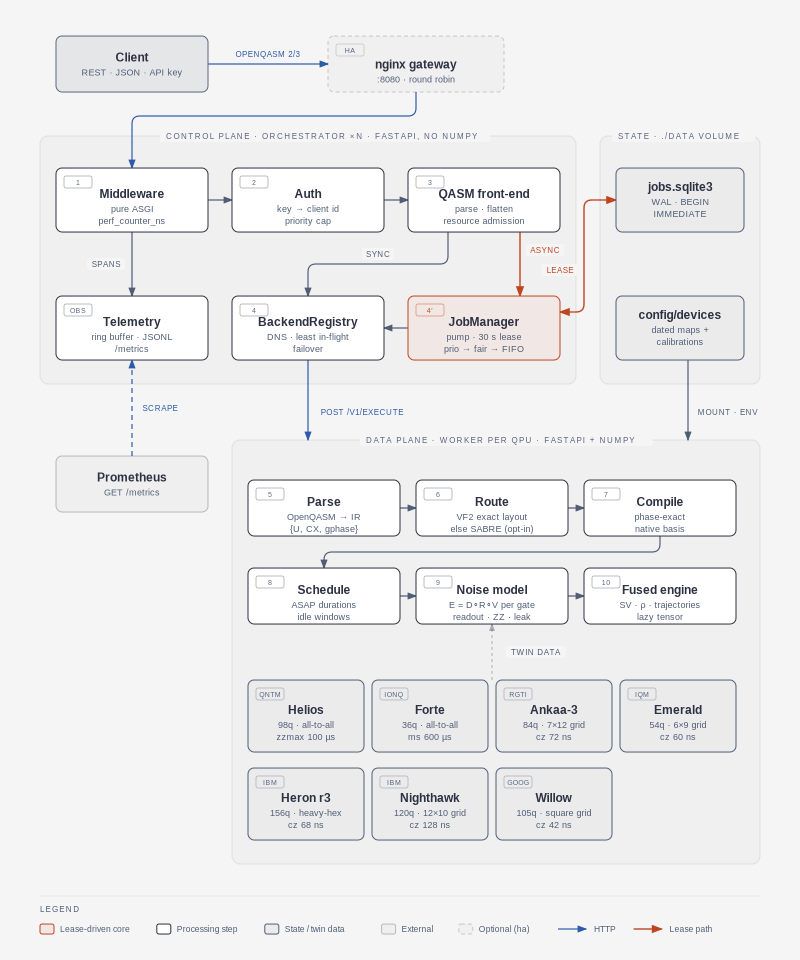
QPUTwin is an open-source quantum digital twin and QPU emulator. It reproduces seven real quantum processors behind one OpenQASM API, modelling each one's native gate set, qubit connectivity, calibrated noise and gate timing. Every processor runs as its own containerised twin; a FastAPI orchestrator routes OpenQASM 2.0/3.x circuits to them and returns results with exact, additive latency telemetry.
| Digital twin | Processor | Technology | Qubits | Connectivity |
|---|---|---|---|---|
quantinuum_helios |
Quantinuum Helios | Trapped ion (QCCD) | 98 | All-to-all |
ionq_forte |
IonQ Forte | Trapped ion | 36 | All-to-all |
rigetti_ankaa_3 |
Rigetti Ankaa-3 | Superconducting | 84 | 7 × 12 square lattice |
iqm_emerald |
IQM Emerald | Superconducting | 54 | 6 × 9 square lattice |
ibm_heron |
IBM Heron r3 (ibm_boston) |
Superconducting | 156 | Heavy-hex (IBM's map) |
ibm_nighthawk |
IBM Nighthawk (ibm_miami) |
Superconducting | 120 | Square lattice (IBM's map) |
google_willow |
Google Willow (willow_pink) |
Superconducting | 105 | Square grid (Google's map) |
The IBM and Google twins are built from the vendors' own published calibration snapshots, with every qubit and coupler.
- Calibration-faithful noise. Each gate's error channel is solved to reproduce its published fidelity exactly, and every calibration value is tagged
publishedorassumed. - Hardware constraints enforced. Phase-exact native compilation; topology violations are rejected, or routed with an opt-in exact-layout-first, calibration-aware SABRE router.
- Three engines, built from scratch. Fused statevector, density-matrix and batched quantum-trajectory engines in
numpy, chosen per job by a cost model, with no vendor or third-party quantum SDK. - A real service. Durable asynchronous jobs with leases, fair sharing and priorities, worker auto-discovery, API keys, Prometheus metrics and an HA gateway.
Prerequisites: Docker with Compose v2, and uv.
git clone https://github.com/Cloudslab/QPUTwin.git qputwin && cd qputwin
docker compose up -d --build                                   # orchestrator + seven twins
curl -s localhost:8000/v1/backends | python3 -m json.tool      # list the emulated QPUs

curl -s localhost:8000/v1/jobs -H 'content-type: application/json' -d '{
  "backend": "ionq_forte",
  "qasm": "OPENQASM 2.0;\ninclude \"qelib1.inc\";\nqreg q[2];\ncreg c[2];\nh q[0];\ncx q[0],q[1];\nmeasure q -> c;",
  "shots": 1000, "seed": 7
}' | python3 -m json.tool
Interactive API documentation is served at http://localhost:8000/docs. Run the tests with uv run pytest.
Measured on a 16-vCPU, 62.8 GiB server against Qiskit Aer, the Amazon Braket local simulators, Cirq, qsim and Qulacs (details):
- Vendors' own workflows. For the same OpenQASM program, a QPUTwin job was faster than IBM's (Qiskit transpile + Aer
from_backend) and Google's (Cirq + qsim with Google's noise model) emulation workflows in 107 of 108 cases, by a geometric mean of 7.1× (Heron r3), 10.2× (Nighthawk) and 4.8× (Willow). - Noisy density matrix. From 10 qubits, 3.2–15× faster than Aer on one thread; Aer is level or ahead on smaller jobs.
- Ideal statevector. Fastest on shallow GHZ circuits at 24 qubits (3.9× qsim on one thread); on deep circuits qsim leads, by 1.9–2.2× at matched single precision on one thread.
- Vendors' own noise models. The IBM and Google twins reproduce them to a median |Δ| of 0.0011–0.0014.
- Saturation. With 21 workers on all 16 vCPUs for ten minutes, all 90 326 light and 5 756 heavy jobs completed, oversized jobs were refused, and no container ran out of memory.
Everything else (installation, the full API, the physics, operations and the benchmark results) is in the documentation site: https://koustavmondal.com/qputwin-docs/.
| Start here | |
|---|---|
| Getting started | installation, quick start, tutorial |
| Concepts | digital twins, architecture, execution pipeline, devices |
| User guide | jobs, OpenQASM, compilation, noise, engines, routing, timing, calibration, telemetry |
| Reference | HTTP API, parameters, responses, errors, configuration |
| Operations | deployment, scaling, security, monitoring |
| Research | benchmarks, simulator comparison, validation, reproducibility, limitations |
Apache License 2.0; see LICENSE and NOTICE.
Koustav Kumar Mondal · koustav@koustavmondal.com